Blog
Méthode BEBEDC + IA : la qualification commerciale B2B réinventée

La qualification commerciale B2B est un art délicat. La méthode BEBEDC (Besoin, Enjeu, Budget, Échéance, Décideurs, Compétiteurs) s’est imposée comme un standard pour structurer la découverte client : claire, complète et facile à déployer sur le terrain.
Les cycles de vente tendent à s’allonger, les décideurs se multiplient et le volume d’informations explose. La réussite de la méthode BEBEDC repose en grande partie sur une préparation rigoureuse et une adaptabilité du déroulé de l’échange. Comment aider le commercial à bien se préparer …
C’est là que l’intelligence artificielle change tout. Intégrée à des outils comme Salesapps, l’IA permet de qualifier plus vite, plus précisément, et avec une pertinence inédite. Et donne toute sa puissance à cette technique.
Dans cet article, découvrez :
– Ce qu’est la méthode BEBEDC et pourquoi elle cartonne
– Comment chaque étape peut être amplifiée par l’IA
– Un cas d’utilisation pour vos équipes commerciales
– Les bonnes pratiques pour passer à l’action
Pourquoi la méthode BEBEDC est devenue incontournable en vente B2B
Toutes les équipes commerciales ont déjà croisé ces acronymes : BANT, SPIN, SONCAS, MEDDIC… Autant de méthodes de qualification, chacune avec ses forces, ses limites et ses cas d’usages adaptés.
La méthode BEBEDC, créée par Carl ROGERS préconise une écoute attentive et le respect du client pour structurer la découverte prospect de manière simple et opérationnelle.
Inspirée de l’écoute active, elle permet de ne rien oublier et de poser les bonnes questions dès le premier échange.
Mais appliquer cette méthode efficacement reste un défi. Selon Salesforce, les meilleurs commerciaux passent plus de 30 % de leur temps à préparer leurs rendez-vous… tout en manquant encore d’informations clés.
La bonne nouvelle ? C’est précisément sur ce point que les agents IA, intégrés dans des plateformes comme Salesapps, apportent un avantage décisif : plus de données, mieux organisées, au bon moment.
Qu’est-ce que la méthode BEBEDC ? Définition et origine
BEBEDC est une méthode qualification commerciale structurée autour de six étapes de qualidication : Besoin, Enjeu, Budget, Échéance, Décideurs, Compétiteurs.
Contrairement à d’autres méthodes comme BANT (Budget, Authority, Need, Timeline) ou MEDDIC (Metrics, Economic Buyer, Decision Criteria, Decision Process, Identify Pain, Champion), BEBEDC intègre dès le départ la dimension concurrentielle (Compétiteurs) et met l’accent sur les enjeux business, pas seulement sur les besoins fonctionnels.
Cette approche en fait un outil particulièrement adapté au marché B2B, où les cycles de vente sont souvent longs, les comités de décision larges, et où la capacité à créer une relation de confiance fait toute la différence.
Pourquoi la méthode BEBEDC fonctionne si bien en vente B2B
La force de BEBEDC réside dans sa simplicité opérationnelle. Pas besoin de formation complexe : les six étapes se mémorisent facilement et se déploient naturellement dans la conversation commerciale.
Elle repose sur un principe clé : comprendre avant de proposer. Plutôt que de pitcher son offre dès les premières minutes, le commercial structure son écoute active autour de six dimensions stratégiques qui vont déterminer la qualité de sa proposition et ses chances de conversion.
BEBEDC permet de :
– Qualifier rapidement une opportunité commerciale (est-ce un vrai deal ou une perte de temps ?)
– Identifier les points de blocage potentiels dès la phase de découverte
– Adapter son discours commercial en fonction du contexte budgétaire, calendrier et décisionnel
– Anticiper la concurrence et construire une proposition différenciante
– Structurer le compte-rendu et le plan d’action post-rendez-vous
Les 6 piliers de la méthode BEBEDC expliqués
La méthode BEBEDC se décompose en six étapes, chacune correspondant à une dimension clé de la qualification commerciale. Voici ce que chaque lettre signifie et pourquoi elle compte dans votre processus de vente.
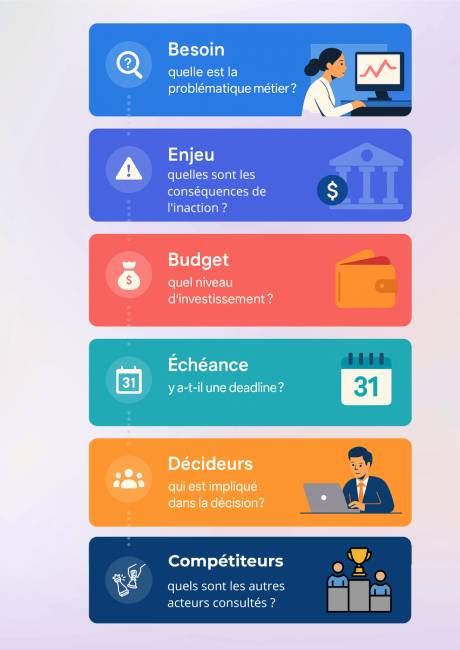
Besoin : quelle est la problématique métier que le prospect cherche à résoudre ? Il ne s’agit pas seulement d’un besoin fonctionnel (exemple : « on cherche un CRM »), mais bien de comprendre la frustration ou l’inefficacité qui motive la recherche. C’est la première porte d’entrée dans la découverte client.
Enjeu : quelles sont les conséquences si rien ne change ? Cette dimension explore le coût de l’inaction, qu’il soit financier, organisationnel ou stratégique. C’est souvent ici que se joue l’urgence d’achat. Un besoin sans enjeu fort ne se transforme que rarement en décision d’achat.
Budget : quel niveau d’investissement est envisagé ou envisageable ? Poser cette question tôt permet d’éviter les mauvaises surprises et d’aligner la proposition commerciale sur la réalité budgétaire du prospect. Attention : il ne s’agit pas de demander « combien tu as ? », mais de comprendre si une enveloppe existe et à quel ordre de grandeur elle correspond.
Échéance : y a-t-il une deadline explicite ou implicite ? Une échéance structure le cycle commercial et permet de prioriser les actions. Elle révèle aussi le degré de maturité du projet : un prospect sans échéance claire est souvent un prospect en phase exploratoire, pas encore prêt à décider.
Décideurs : qui décide vraiment, qui influence, qui peut bloquer ? Identifier les bons interlocuteurs est une compétence clé en vente B2B. Il ne suffit pas de parler au bon contact : il faut comprendre toute la cartographie décisionnelle, du sponsor au comité de validation, en passant par les utilisateurs finaux.
Compétiteurs : qui d’autre est en lice ou consulté ? Connaître la concurrence permet d’adapter son discours, d’anticiper les objections et de se différencier. Cette dimension est souvent sous-estimée, alors qu’elle conditionne directement la stratégie de positionnement et l’angle d’attaque commercial.
Ces six étapes forment un tout cohérent, une grille de lecture complète pour qualifier une opportunité. Les appliquer efficacement demande du temps, de la rigueur et surtout : de l’information. C’est là que l’IA entre en jeu.
Comment l’IA transforme la méthode BEBEDC en avantage compétitif
La méthode BEBEDC repose sur une logique puissante : poser les bonnes questions pour qualifier une opportunité commerciale. Mais aujourd’hui, le volume d’informations à traiter, la complexité des cycles d’achat et l’exigence de personnalisation rendent cette démarche plus difficile… sauf si elle est augmentée par l’intelligence artificielle.
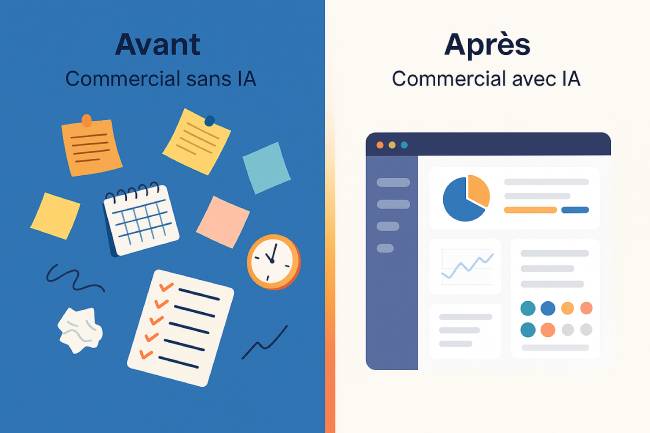
Chaque étape du BEBEDC peut être renforcée grâce à une IA spécialisée comme celle des agents IA de Salesapps, qui prépare en amont, alimente l’échange et structure le rendez-vous. Le résultat : des commerciaux mieux outillés, des rendez-vous plus efficaces, et un taux de conversion qui grimpe.
Les 6 étapes de BEBEDC boostées par les agents IA Salesapps
La méthode BEBEDC, c’est un peu comme avoir une carte routière pour vos rendez-vous clients. Le problème ? Une carte ne sert à rien sans
préparation des étapes pour atteindre son but.
C’est exactement le rôle des agents IA de Salesapps : transformer votre qualification en un véritable assistant de terrain, toujours prêt à vous préparer, vous accompagner et vous faire gagner du temps.
Voyons comment ces agents donnent vie à chaque étape du BEBEDC.
Avant le rendez-vous : poser les bonnes bases (Besoin, Enjeu, Budget)
Vous connaissez cette sensation ? Un rendez-vous important approche, et vous vous dites : “Je devrais creuser un peu sur cette boîte… mais par où commencer ?”
Entre le site web, LinkedIn et Google, on finit souvent par passer vingt minutes à chercher sans vraiment savoir quoi retenir. Et ce flou se retrouve côté acheteurs : 41 % disent que leurs besoins sont mal compris. (LinkedIn x Ipsos, 2024)
Imaginez : vous lancez l’agent, et en quelques secondes, il vous livre une fiche synthétique de l’entreprise. Vous n’aurez pas un roman de 15 pages, mais l’essentiel : leur actualité récente (levée de fonds, nouveau produit, rachat…), les enjeux de leur secteur, et même des signaux d’affaires qui vous mettent sur la piste d’une opportunité.
Exemple : une entreprise de retail annonce une levée de cinq millions d’euros.
Company Profiler met l’information en avant : vous savez qu’elle entre en phase de croissance, avec des besoins d’équipement ou de formation. Vous avez votre angle d’attaque.
Ensuite vient Individual Profiler.
Parce qu’en face de vous, ce n’est pas “une entreprise” mais une personne, avec ses priorités et son histoire. L’agent analyse son profil LinkedIn, repère ses publications et suggère des points d’accroche naturels.
Votre contact a posté sur la transformation digitale ? Parfait : vous ouvrez l’échange sur ce sujet et montrez que vous avez fait vos devoirs. En quelques mots, la connexion est créée.
Pendant et après : structurer, synthétiser, avancer (Échéance, Décideurs, Compétiteurs)
Avant même de parler de suivi, il y a un moment clé dans tout cycle de vente : celui où vous devez trouver rapidement la bonne information pour convaincre. Un argument qui fait mouche, un cas client pertinent, un chiffre qui parle. Et là, le problème est toujours le même : où est cette information ? Dans quel document ? Sur quelle slide ?
C’est exactement le rôle du Sales Assistant.
Imaginez un copilote IA intégré directement dans votre application. Vous préparez une proposition, une question vous vient. Vous posez la question au Sales Assistant, et il vous répond instantanément en s’appuyant uniquement sur les contenus validés et publiés dans Salesapps par votre entreprise. Pas de risque d’approximation, pas d’information obsolète : tout est contrôlé, sécurisé, fiable.
Le Sales Assistant comprend votre besoin, retrouve les bons supports, reformule les arguments si nécessaire, et vous aide à construire un discours aligné sur la stratégie commerciale de votre organisation. Un copilote simple à utiliser, qui vous fait gagner du temps quand vous en avez besoin et renforce votre impact commercial.
Exemple : vous préparez une proposition pour un prospect sensible au ROI court terme. Vous interrogez le Sales Assistant : « Quels arguments mettre en avant pour un ROI rapide ? » L’agent vous renvoie trois arguments clés, un cas client pertinent, et même les slides à utiliser pour appuyer votre discours.
Le rendez-vous se passe bien. Vous posez les bonnes questions, votre interlocuteur s’ouvre, les échanges sont riches. Mais voilà le piège classique : vous ressortez avec plein d’informations en tête, ce qui est critique dans un cycle de vente (qui dure en moyenne 68,7 jours – Gong 2025.) et chaque commercial va les noter différemment.
Or cette prise de notre est chronophage. Et surtout, elle manque de structure. Un commercial note « échéance fin du mois », un autre écrit « validation prévue Q1 », un troisième oublie carrément de consigner l’information dans le CRM. Résultat : des données commerciales hétérogènes, difficiles à exploiter, et un suivi qui perd en efficacité.
Note Taker règle ce problème dès la fin du rendez-vous.
Le commercial dicte à voix haute les grandes lignes de l’échange ; besoins, enjeux, échéances, interlocuteurs clés.
L’agent résume ces notes et génère automatiquement un compte rendu structuré autour du BEBEDC, prêt à partager. En quelques minutes, tout est consigné, sans rien oublier.
Exemple : pendant le rendez-vous, le prospect mentionne qu’il doit présenter une short-list à sa direction avant la fin du mois. Le commercial le dicte aussitôt après, et Note Taker intègre cette échéance dans le compte rendu.
Résultat : un suivi rigoureux, des relances dans les temps, et souvent, un deal mieux maîtrisé.
Maintenant, parlons de vos contenus commerciaux. Vous avez des dizaines de cas clients, de fiches produits, de présentations. Mais pour qu’ils soient vraiment utiles, encore faut-il que vos commerciaux sachent ce qu’ils contiennent et quand les utiliser.
C’est là qu’intervient le Doc Summarizer.
Cet agent IA ne se contente pas de résumer vos documents. Il les enrichit avec des métadonnées stratégiques :
- Un résumé synthétique du contenu
- Un elevator pitch pour présenter le document en 30 secondes
- Les arguments clés sur la méthode ou l’approche
- Les questions auxquelles le contenu répond
- Les KPI principaux mis en avant
Résultat : vos contenus deviennent instantanément plus exploitables. Le commercial sait en un coup d’œil si ce cas client correspond à son prospect, quels arguments il peut en tirer, et quels résultats mettre en avant.
💡 Exemple : vous avez un cas client de 12 pages sur un projet de transformation digitale dans le retail. Doc Summarizer génère automatiquement : (résumé, Elevator pitch, Arguments clés…)
Le résultat ? Vous ne partez plus jamais de zéro.
Avec cette suite d’agents IA, chaque étape du BEBEDC gagne en précision, rapidité et impact.
Vous arrivez en rendez-vous avec le bon contexte, menez votre découverte de façon structurée et suivez vos opportunités sans rien oublier.
L’IA ne remplace pas la méthode BEBEDC. Elle ne remplace pas non plus le talent de vos commerciaux, ni leur capacité à créer du lien et à convaincre.
Elle leur fait gagner du temps, allège leur charge mentale et leur permet de se concentrer sur l’essentiel : comprendre leurs clients, instaurer une relation de confiance durable et construire des propositions réellement pertinentes.
5 bonnes pratiques pour déployer la méthode BEBEDC avec l’IA
Vous êtes convaincu par l’intérêt de combiner la méthode BEBEDC et l’intelligence artificielle ? Voici 5 bonnes pratiques pour passer à l’action et transformer vos processus de vente.
1. Formez vos équipes à la méthode BEBEDC avant tout
L’IA est un accélérateur, pas un substitut. Avant de déployer des outils, assurez-vous que vos commerciaux maîtrisent les fondamentaux de la qualification commerciale. Organisez des ateliers pratiques, des jeux de rôle, des debriefs de rendez-vous. La méthode BEBEDC doit devenir un réflexe, pas une contrainte.
Conseil : intégrez BEBEDC dans vos grilles d’évaluation des opportunités CRM. Chaque deal doit pouvoir être qualifié sur les six dimensions avant de passer au stade suivant.
2. Utilisez l’IA pour préparer, pas pour improviser
L’erreur classique : attendre le dernier moment pour lancer un Company Profiler ou un Individual Profiler. L’IA est plus efficace quand elle est utilisée en amont, dans une logique de préparation structurée.
Conseil : instaurez un rituel de préparation systématique 24 à 48 heures avant chaque rendez-vous client. Bloquez 15 minutes dans l’agenda de vos commerciaux pour cette étape. C’est un investissement qui génère un ROI immédiat en qualité d’échange.
3. Capitalisez sur les données pour améliorer en continu
Chaque rendez-vous génère des informations précieuses : objections rencontrées, arguments qui fonctionnent, profils de décideurs, cycles de vente moyens. Utilisez les outils IA pour capturer ces données et les analyser.
Conseil : organisez des revues trimestrielles avec vos équipes commerciales pour identifier les patterns récurrents. Quels sont les enjeux qui reviennent le plus souvent ? Quels budgets sont les plus fréquents ? Quels compétiteurs sont systématiquement en face ? Ces insights permettent d’affiner votre stratégie commerciale.
4. Personnalisez sans sacrifier l’efficacité
L’IA vous donne accès à une masse d’informations sur chaque prospect. Identifiez les informations les plus pertinentes pour construire votre approche commerciale.
Conseil : concentrez-vous sur 2 à 3 points d’accroche maximum par prospect. Un article LinkedIn récent, une actualité entreprise, une connexion commune. Cela suffit pour créer une relation de confiance sans perdre de temps.
5. Mesurez l’impact sur vos KPIs commerciaux
L’adoption de la méthode BEBEDC couplée à l’IA doit se traduire par des résultats mesurables : augmentation du taux de conversion, réduction du cycle de vente, amélioration de la taille moyenne des deals.
Conseil : définissez vos indicateurs de performance avant le déploiement, et suivez-les de façon rigoureuse. Comparez les résultats des commerciaux qui utilisent l’IA versus ceux qui ne l’utilisent pas encore. Les écarts se voient rapidement dans les résultats.
Conclusion : la méthode BEBEDC à l’ère de l’intelligence artificielle
La vente B2B est un métier exigeant. Les cycles s’allongent, les décideurs se multiplient, la concurrence s’intensifie. Dans ce contexte, avoir une méthode de qualification solide comme BEBEDC alimentée par l’IA et une plateforme de Modern Selling permet de l’appliquer avec rapidité, pertinence et constance.
Les agents IA rendent le commercial plus efficace, mieux préparé, plus stratégique. Ils transforment la méthode BEBEDC en un véritable avantage compétitif.
Les bénéfices sont immédiats :
– Vous préparez chaque rendez-vous avec les bonnes informations, au bon moment
– Vous structurez votre découverte client autour des six dimensions clés
– Vous créez une relation de confiance dès les premières minutes
– Vous construisez des propositions différenciantes, alignées sur les vrais enjeux
– Vous accélérez le cycle de vente et améliorez votre taux de conversion
Alors, prêt à transformer votre approche de la découverte client ? Vous souhaitez découvrir comment Salesapps peut transformer votre approche de la découverte client ? Demandez une démo personnalisée et testez la puissance de l’IA.
FAQ : tout savoir sur la méthode BEBEDC et l’IA
Qu’est-ce que la méthode BEBEDC en vente B2B ?
La méthode BEBEDC est une technique de qualification commerciale structurée en six étapes : Besoin, Enjeu, Budget, Échéance, Décideurs, Compétiteurs. Développée par Uptoo, elle permet aux commerciaux de structurer leur découverte client de façon complète et méthodique. Chaque étape explore une dimension clé de l’opportunité commerciale, de la problématique métier à résoudre jusqu’à l’identification de la concurrence.
Comment l’intelligence artificielle améliore-t-elle la qualification commerciale ?
L’IA améliore la qualification commerciale en automatisant la collecte et l’analyse des informations sur les prospects. Des outils comme Salesapps permettent de préparer les rendez-vous plus rapidement, d’identifier les enjeux business, de cartographier les décideurs, et de structurer le suivi. L’IA libère du temps pour les commerciaux, qui peuvent se concentrer sur la relation client et la négociation plutôt que sur la recherche d’informations.
Quelle est la différence entre BEBEDC et MEDDIC ?
BEBEDC et MEDDIC sont deux méthodes de qualification commerciale complémentaires. MEDDIC (Metrics, Economic Buyer, Decision Criteria, Decision Process, Identify Pain, Champion) est plus orientée vers les cycles de vente complexes et met l’accent sur les métriques et le processus de décision. BEBEDC est plus simple, plus accessible, et intègre dès le départ la dimension concurrentielle. Elle est particulièrement adaptée au marché B2B.
Comment préparer un rendez-vous client avec l’IA ?
Pour préparer un rendez-vous client avec l’IA, commencez par utiliser un outil comme Company Profiler pour analyser l’entreprise cible, ses actualités et ses enjeux. Ensuite, activez Individual Profiler pour identifier les décideurs et trouver des points d’accroche personnalisés. Utilisez Sales Assistant pour préparer vos arguments et vos contenus. Enfin, après le rendez-vous, capitalisez avec Note Taker pour structurer le compte-rendu et le plan d’action.
La méthode BEBEDC fonctionne-t-elle pour tous les secteurs B2B ?
Oui, la méthode BEBEDC est universelle et s’applique à tous les secteurs B2B : logiciels, industrie, services, conseil, équipements professionnels, etc. Ses six étapes couvrent les dimensions essentielles de toute vente consultative. Elle peut être adaptée en fonction de la complexité du cycle de vente, mais le cadre reste pertinent quel que soit le secteur.
Combien de temps faut-il pour former une équipe à la méthode BEBEDC ?
La méthode BEBEDC est simple et rapide à assimiler. Une formation initiale d’e une à deux journées suffit généralement pour que les commerciaux comprennent les six étapes et sachent les appliquer. L’essentiel est ensuite de pratiquer régulièrement, d’organiser des débriefs de rendez-vous, et d’intégrer BEBEDC dans les process CRM. Avec l’accompagnement de l’IA, l’adoption est encore plus rapide.
Peut-on utiliser BEBEDC pour la prospection téléphonique ?
Absolument. La méthode BEBEDC s’applique aussi bien aux rendez-vous en face-à-face qu’à la prospection téléphonique ou aux visioconférences. L’important est de structurer son questionnement autour des six dimensions, quel que soit le canal. L’IA peut d’ailleurs aider à préparer les appels de prospection en fournissant des informations contextuelles sur les prospects à contacter.
Quels outils IA sont compatibles avec la méthode BEBEDC ?
Plusieurs outils d’intelligence artificielle peuvent être utilisés pour renforcer la méthode BEBEDC. Salesapps propose une suite complète avec Company Profiler, Individual Profiler, Sales Assistant et Note Taker. D’autres plateformes de sales enablement, d’intelligence conversationnelle ou de CRM augmenté intègrent également des fonctionnalités IA compatibles avec une approche BEBEDC.
L’IA peut-elle remplacer le commercial dans la qualification ?
Non, l’IA ne remplace pas le commercial. Elle l’assiste, le prépare et le rend plus efficace. La qualification commerciale repose avant tout sur l’écoute active, l’empathie, la capacité à créer une relation de confiance et à poser les bonnes questions au bon moment. L’IA fournit les informations et structure les données, mais c’est le commercial qui mène l’échange et construit la proposition de valeur.
Comment mesurer l’efficacité de la méthode BEBEDC dans mon équipe ?
Pour mesurer l’efficacité de BEBEDC, suivez plusieurs indicateurs : taux de conversion des opportunités qualifiées, durée moyenne du cycle de vente, taille moyenne des deals, qualité des comptes-rendus de rendez-vous, et taux d’adoption de la méthode par les équipes. Vous pouvez également comparer les performances des commerciaux qui appliquent rigoureusement BEBEDC versus ceux qui ne l’utilisent pas encore.