
Blog
Agents IA : définition et impact sur la performance commerciale
Dans Marketing, Sales Enablement, Technique
En 2024, l’IA générative a fait une entrée fracassante dans les équipes marketing et commerciales. Selon Hubspot, 65% des commerciaux ont déclaré utiliser l’IA au quotidien. Mais en 2025, c’est une nouvelle génération d’outils qui s’installe : les agents IA
Ces assistants ont vocation à épauler les équipes commerciales dans leur activité, à maximiser leur impact et à les aider à faire la différence. Moins visibles que l’IA générative, mais bien plus ciblés, ils travaillent au service d’objectifs, dans un cadre maîtrisé, pour gagner du temps, affiner le discours commercial et renforcer l’impact.
Que peuvent-ils apporter, concrètement, aux équipes sales et marketing ? Et pourquoi les directions commerciales ont tout intérêt à s’en emparer dès maintenant ?
Qu’est-ce qu’un agent IA ?
Un agent IA est un logiciel intelligent qui intègre un ou plusieurs moteurs d’intelligence artificielle, conçu pour atteindre des objectifs définis par sa fonction pour un contexte métier donné. Il ne fonctionne pas seul : il intervient en soutien, dans un cadre bien balisé, en analysant des données et en proposant des actions adaptées à la situation. L’agent IA a la capacité à questionner le commercial pour affiner sa compréhension.
Contrairement à l’IA générative, sa spécialisation métier lui permet d’être extrêmement précis, même avec peu d’instructions. C’est un peu une IA Générative boostée à la connaissance métier et process. L’agent IA sélectionne les meilleures informations ou recommandations pour accompagner une action commerciale : mieux préparer un rendez-vous, structurer un argumentaire, prioriser les opportunités, etc.
L’agent IA renforce donc sensiblement la capacité d’analyse, de décision et d’exécution du commercial. C’est un assistant IA pour la force de vente, taillé pour les accompagner à chaque étape décisive de leur cycle de vente.
Agent IA vs IA générative : deux logiques, deux usages
L’IA générative, aujourd’hui largement démocratisée avec des outils comme Mistral, ChatGPT, Perplexity, DeepSeek, Claude ou encore Gemini est conçue pour produire du contenu à partir d’instructions : les fameux prompts. Texte, image, script : elle génère ce qu’on lui demande, mais sans réelle compréhension du contexte métier, ni des objectifs à atteindre. Elle est efficace… à condition d’être bien cadrée. Sinon, elle peut produire des résultats imprécis, voire hors sujet. Ces prompts deviennent parfois de véritables cahiers des charges, complexes et fastidieux à rédiger, visant à guider, cadrer, définir le format attendu, et génère parfois des résultats professionnellement peu satisfaisants.
À l’inverse, un agent IA ne produit pas du contenu “brut”. Il agit dans un cadre défini, avec un objectif clair, généralement posé par les équipes marketing ou commerciales. Il s’appuie sur l’IA générative, mais dans une logique bien différente : orientée action, filtrée par les besoins du métier, et encadrée par des règles précises prédéfinies.
Exemple : là où une IA générative peut rédiger un email de prospection si on lui donne un brief complet, un agent IA saura identifier le bon angle d’approche pour un prospect donné, en fonction de son profil, du contexte du rendez-vous et des priorités commerciales de l’entreprise.
Autre exemple : tout le monde s’est amusé avec les fameux Starter Pack, voici par exemple le script pour le rendu d’un Starter Pack Salesapps :
« Crée un rendu 3D de haute qualité d’une figurine en style cartoon, présentée sous blister, à la manière d’un jouet de collection. Le fond en carton est <COULEUR> et porte une étiquette de jouet rétro. En haut au centre, en grandes lettres majuscules et en gras, dans un cadre jaune au contour noir, écris « STARTER PACK ». Juste en dessous, tu peux écrire <NOM> en plus petit en bas à droite. En haut à droite, un badge bleu circulaire indique « ACTION FIGURE ». En haut à gauche, une petite bulle blanche indique « 4+ ».
Le personnage se tient debout, moulé dans une boîte en plastique transparente fixée sur un support en carton plat. Il doit ressembler à la photo que je joins. Son visage est <CARACTÉRISTIQUES DU VISAGE>, avec une pose <CARACTÉRISTIQUES DE LA POSE>. Le ton général est léger et réaliste.
La figurine porte <INDIQUER LES VÊTEMENTS + COULEURS>. Sur le côté de la figurine, intégrés dans des moules en plastique distincts, expose 3 accessoires miniatures : <ACCESSOIRE 1>, <ACCESSOIRE 2>, <ACCESSOIRE 3>. Chaque accessoire s’insère parfaitement dans son propre compartiment moulé.
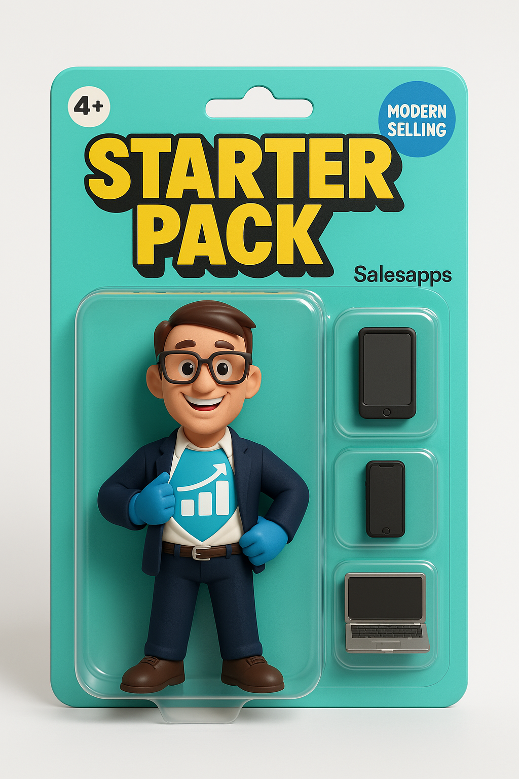
L’emballage est photographié ou rendu avec des ombres douces, un éclairage uniforme et un fond blanc épuré pour donner l’impression d’une séance photo commerciale. Le style doit allier réalisme et stylisation du dessin animé 3D, à l’image de Pixar ou des maquettes de jouets modernes. Assure-toi que la disposition et les proportions du produit ressemblent à celles d’un véritable jouet vendu en magasin.«
👉 L’agent IA ne remplace ni le jugement du commercial, ni sa posture relationnelle. Il structure simplement une aide intelligente à la décision, pensée pour les enjeux concrets de la vente B2B.
Agents IA : 3 bénéfices pour booster la vente
Sur le terrain, les agents IA changent déjà la façon de préparer, conduire et suivre un rendez-vous commercial.
Plus qu’un assistant numérique, c’est un outil d’aide à la vente conçu pour alléger les tâches chronophages et permettre aux équipes de se concentrer sur l’essentiel : vendre.
Voici trois bénéfices observés dans les équipes B2B qui l’ont adopté.
Recentrer les commerciaux sur la vente
Selon le rapport State of Sales de LinkedIn, les commerciaux consacrent en moyenne 67 % de leur temps à des tâches non liées à la vente, dont 19 % pour l’administratif et 17 % pour la mise à jour du CRM. L’agent IA permet de réduire cette charge en synthétisant automatiquement les informations clés avant un rendez-vous, ou en prenant en charge certaines actions de suivi. Résultat : les commerciaux passent moins de temps à s’organiser, sont mieux préparés et peuvent se concentrer sur la vente.
Mieux personnaliser, au bon moment
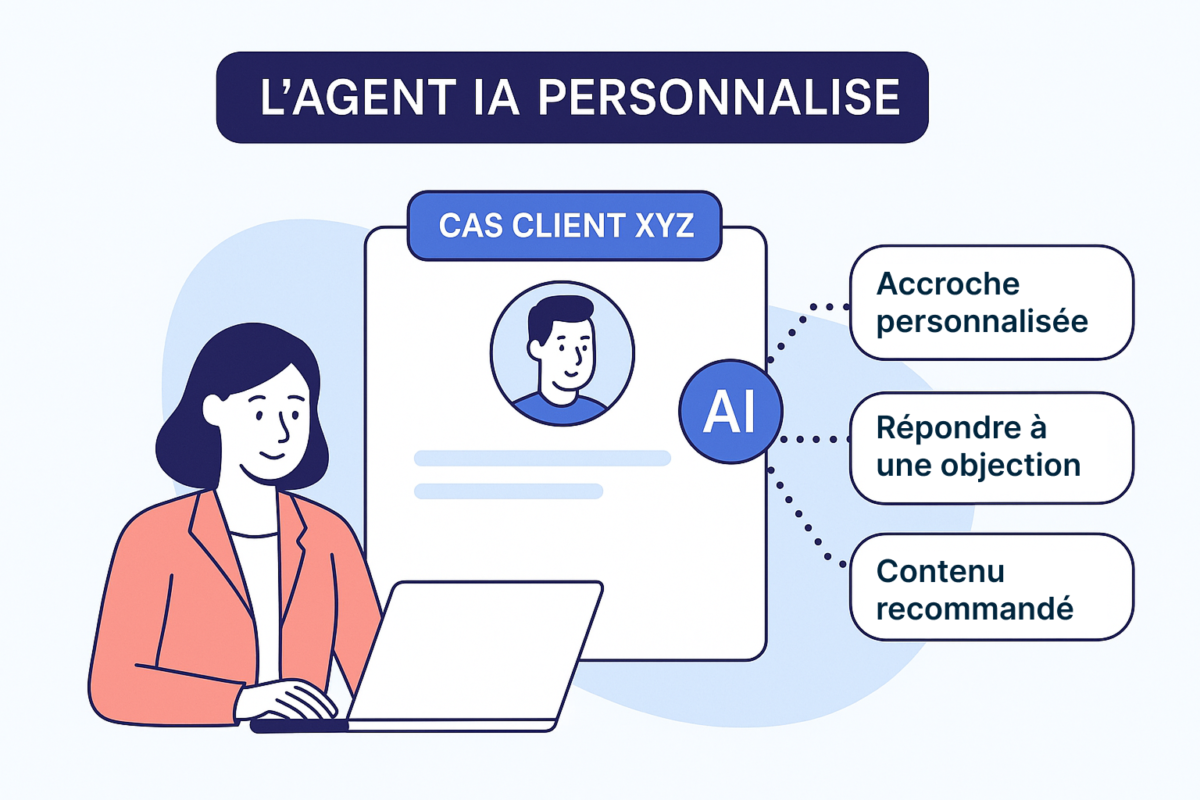
D’après une étude de Forrester, la personnalisation peut améliorer les taux de conversion de 40 %. Et selon le Global B2B Payments Playbook, 85 % des acheteurs B2B considèrent que l’expérience d’achat est aussi importante que le produit ou service en lui-même.
Dans ce contexte, l’agent IA devient un levier précieux pour aider les commerciaux à contextualiser leur discours. Il peut suggérer des accroches en lien avec les enjeux du prospect, anticiper des objections, ou recommander les contenus les plus pertinents selon le moment du cycle de vente. L’analyse du profil de votre interlocuteur et de son entreprise vous donne un coup d’avance pour engager votre approche ou négociation avec les meilleures cartes en main.
Accélérer la montée en compétences
Un agent IA ne se contente pas d’assister le commercial dans l’instant. En analysant les données issues des échanges précédents, il identifie des axes de progression concrets : posture, argumentaire, rythme, ou pertinence des réponses.
Cette approche permet de faire de chaque interaction un levier de formation continue, sans formaliser de programme lourd. C’est une forme d’apprentissage intégré au quotidien, personnalisée, et orientée résultats.
Comment un commercial utilise un agent IA à chaque étape de son cycle de vente
L’agent IA s’insère naturellement dans le quotidien du commercial pour l’épauler aux bons moments : ceux qui font la différence dans une vente. Voici comment il agit, en toute simplicité.
Avant un rendez-vous : analyse ciblée, aide à la priorisation, construction d’un pitch pertinent
Antoine, commercial en B2B, commence sa journée avec un rendez-vous important. Plutôt que de passer une heure à éplucher les infos disponibles, il s’appuie sur son agent IA pour accéder rapidement à l’essentiel : le contexte de l’entreprise, les enjeux identifiés, les derniers échanges, les signaux d’intérêt récents… Son agent IA peut également le renseigner sur le profil de son interlocuteur, les opportunités et les risques liés à son rôle dans l’entreprise.
En quelques minutes, il dispose d’un brief synthétique qui lui permet de se concentrer sur l’essentiel. Ce n’est pas un résumé basique. C’est une analyse sur-mesure : signaux d’intérêt récents, points sensibles, enjeux business à valoriser… Antoine peut ainsi affiner son approche, adapter son discours, et rentrer dans son rendez-vous avec une longueur d’avance.
Pendant le rendez-vous : support discret, fluidité de l’échange, maintien du cap
Par exemple, face à son interlocuteur, Antoine engage l’échange avec un ton d’avance, présente naturellement des arguments qui résonnent pour son interlocuteur et gagne rapidement en crédibilité. Il peut compter sur son agent IA pour le soutenir si besoin : une information à vérifier, un chiffre à retrouver, une objection à recadrer.
L’agent intervient sans perturber l’échange, en apportant une aide ciblée qui lui permet de rester fluide, confiant, et centré sur la conversation. Le commercial reste aux commandes, mais il est mieux outillé pour rebondir.
Après : structuration du suivi, montée en compétences
Le rendez-vous terminé, Antoine ne perd pas le fil. L’agent IA l’aide à structurer immédiatement le suivi : points abordés, actions à engager, éléments à transmettre. Un email de remerciement est prêt à partir, le CRM est mis à jour, et les prochaines étapes sont claires. Tout le suivi commercial est automatisé : synthèse des échanges, relances à planifier, contenus à transmettre. Le commercial reste aligné, sans effort, et sans risque d’oubli.
Mieux encore : en analysant l’échange, il identifie les éléments à creuser lors du prochain contact, les objections non résolues, ou les contenus à envoyer en complément. Antoine gagne du temps, et la qualité du suivi ne dépend plus de sa mémoire ou de sa to-do perso.
À retenir : l’agent d’intelligence artificielle ne remplace pas le commercial, il structure son action et lui permet d’être plus pertinent, plus rapide, et plus serein, sans se disperser.
Comment le marketing utilise les agents IA pour mieux soutenir la vente
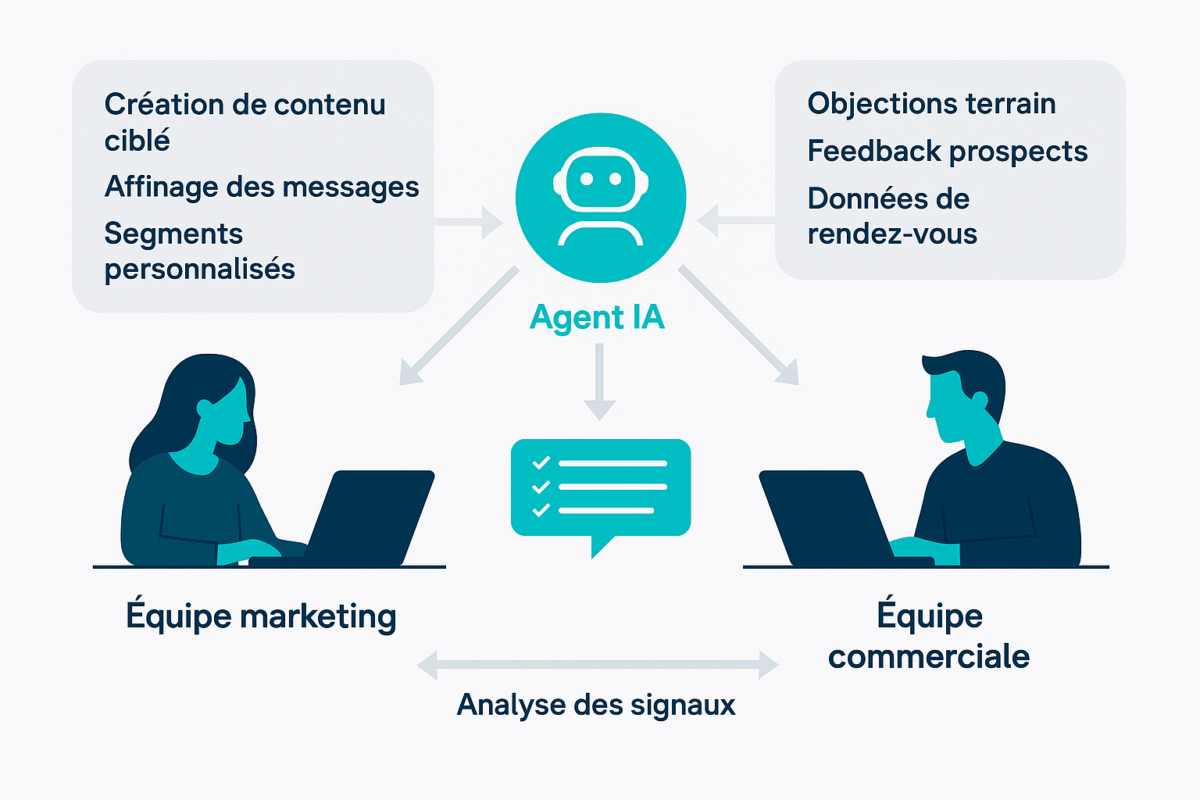
Le marketing ne travaille plus en silo. Sa mission va bien au-delà de la génération de leads : il doit aussi outiller les commerciaux, affiner les messages, et renforcer la pertinence des actions sur le terrain. C’est précisément là que les agents IA entrent en jeu.
Grâce aux insights qu’ils produisent, ces agents permettent au marketing de mieux comprendre les enjeux des prospects : ce qui les intéresse, les contenus consultés, les objections fréquentes… Des données précieuses, qui ne sortaient autrefois jamais du terrain.
Résultat ? Les équipes marketing peuvent adapter leurs contenus, affiner les segments, et créer des supports bien plus efficaces, pas en théorie, mais en phase avec la réalité des conversations commerciales.
Un exemple concret : après plusieurs rendez-vous, votre agent IA peut vous aider à identifier une tendance récurrente autour d’un frein à l’achat. Le marketing peut alors produire un contenu ciblé qui aide le commercial à le lever plus facilement lors de ses prochains échanges.
Autre impact : la personnalisation. En croisant les informations recueillies par les commerciaux et les signaux comportementaux remontés par l’agent IA, le marketing peut proposer des messages, des accroches ou des séquences beaucoup plus fines sans alourdir la charge opérationnelle par contenu.
Plus qu’une révolution technologique, c’est un alignement stratégique autour d’un objectif commun : permettre aux commerciaux d’être plus convaincants, plus vite.
Agents IA : ce qu’ils transforment dans les équipes commerciales et marketing
| Sans l’agent IA | Avec l’agent IA |
| Beaucoup de temps passé à rechercher, trier, résumer | Accès rapide à l’essentiel, sans surcharge d’infos |
| Préparation de rendez-vous inégale selon les profils | Préparation structurée, homogène et contextualisée |
| Difficulté à personnaliser à grande échelle | Personnalisation ciblée à chaque étape du cycle |
| Suivi client dépendant de la rigueur individuelle | Suivi fluide, automatisé et aligné avec le CRM |
| Contenus marketing parfois déconnectés du terrain | Alignement renforcé grâce aux insights du terrain |
| Peu de retours concrets pour améliorer la posture commerciale | Recommandations régulières pour progresser au fil des rendez-vous |
Les agents IA développés par Salesapps : pensés pour votre vente terrain
Les agents IA ont été lancés en direct lors de notre 3ème édition des meetups de l’excellence commerciale. Chez Salesapps, notre vision est de développer des agents IA destinés à améliorer l’efficacité commerciale. Ainsi, plusieurs agents IA sont amenés à booster la performance de l’outil : Company Profiler, Individual Profiler, Notetaker et Document Summarizer.. Ces agents, simples à utiliser (pour tous types de profils commerciaux), fournissent des informations précises et synthétisées, facilitant ainsi leur exploitation par le commercial, afin d’assurer une préparation pertinente.
| Agent IA | Son rôle dans la vente |
| Company Profiler | Synthétise les infos clés sur l’entreprise cible pour préparer efficacement le rendez-vous |
| Individual Profiler | Aide à comprendre l’interlocuteur et à personnaliser le discours commercial |
| Notetaker | Structure automatiquement le suivi post-rendez-vous et propose des axes d’amélioration |
| Document Summarizer | Analyse instantanée des documents, leur usage, les messages clés, etc. |
Ces agents, intégrés à Salesapps, donnent les bons repères pour mieux convaincre et simplifient le reporting.
Conclusion : L’agent IA, un nouveau réflexe commercial
Dans un contexte où chaque rendez-vous compte, où chaque message doit être précis et pertinent, les agents IA apportent une nouvelle forme d’intelligence : une intelligence appliquée, au service de la performance commerciale.
Ils donneront à vos commerciaux les bons réflexes, au bon moment pour convaincre plus vite, et mieux.
Chez Salesapps, nous sommes convaincus que la force de vente reste humaine, mais qu’elle peut s’appuyer sur des leviers puissants, pensés pour son métier.
Envie de voir ce que cela donnerait dans votre contexte ?
Demandez une démo personnalisée de nos agents IA et découvrez comment ils peuvent renforcer votre efficacité commerciale, dès aujourd’hui.
FAQ
Un chatbot est conçu pour répondre à des demandes simples, souvent via un scénario préétabli (FAQ, prise de RDV, support client).
Un agent d’intelligence artificiel, lui, va plus loin : il interagit avec un environnement métier, collecte et croise différentes sources de données, et propose des actions adaptées à une situation donnée. Il agit comme un assistant stratégique, pas comme un outil de réponse automatique.
Une IA générative produit du contenu à partir de consignes. Elle est utile pour rédiger ou créer, mais sans cadre métier, elle peut générer des erreurs ou des contenus hors sujet.
Un agent IA, au contraire, est calibré pour un usage professionnel précis. Il exploite la puissance de l’IA générative, mais dans un cadre défini par l’entreprise, avec des objectifs clairs (préparer un rendez-vous, structurer un suivi, etc.).
Les agents IA sont particulièrement utiles pour les équipes commerciales B2B qui gèrent des cycles de vente complexes, des rendez-vous fréquents, et des attentes élevées en matière de personnalisation.
Ils apportent une aide concrète à toutes les équipes qui veulent vendre plus efficacement, sans alourdir leurs process.
Les agents IA aident les commerciaux à gagner du temps, mieux préparer leurs rendez-vous et personnaliser leur discours. Ils facilitent l’accès aux bonnes informations au bon moment, tout en simplifiant le suivi après l’échange.
Résultat : des rendez-vous plus efficaces, un meilleur taux de conversion, et des équipes plus confiantes au quotidien.