Blog
Comment mettre en place une stratégie de Sales Enablement efficace ?
Dans Sales Enablement, Technique

L’application de Sales Enablement, également appelée outil d’aide à la vente, est devenue un élément indispensable pour toutes les entreprises cherchant à aligner leurs équipes Sales & Marketing en temps réel, à offrir une expérience client en rendez-vous et à améliorer leur performance commerciale. Cependant, la mise en place d’une stratégie de Sales Enablement ne s’improvise pas. Elle nécessite de répondre à des enjeux précis, d’impliquer différents acteurs et doit être séquencée par étape pour être efficace.
I) Quels sont les profils à impliquer dans votre stratégie de Sales Enablement ?
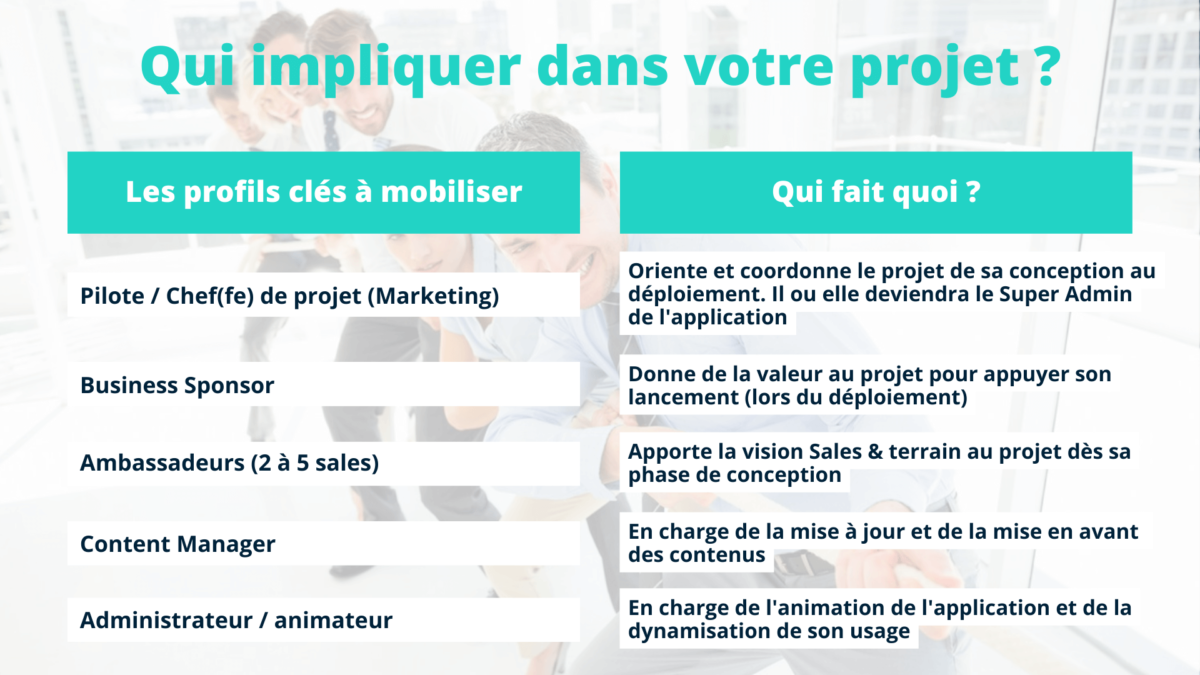
Concevoir une application de Sales Enablement performante est un véritable défi. Embarquer 100% des commerciaux dès le lancement et assurer un taux d’usage élevé dans le temps l’est encore plus. Pour réussir, il faut réunir une équipe gagnante !
– Et ça commence par le pilote / chef de projet. Cette personne oriente et coordonne le projet de sa conception au déploiement. « Dans les deux-tiers des cas, ils sont issus de la direction marketing. Dans un tiers, de la direction commerciale. Parfois, ce sont des responsables de la performance commerciale ou des outils commerciaux », assure Stephane Renger, CEO Salesapps. Très répandu aux États-Unis et au Royaume-Uni, le Sales Enablement est une discipline en pleine croissance en France. C’est ce que nous avons constaté sur LinkedIn avec l’apparition d’une nouvelle fonction : le Sales Enablement Manager. Celui-ci est directement rattaché à la direction marketing & commerciale et a pour missions principales de gérer la performance des équipes commerciales, les aligner sur les objectifs de l’entreprise et mesurer leur rendement.
– La seconde personne à impliquer est un Business Sponsor afin de faire la promotion de l’outil. Souvent oublié par les organisations, il donne de la valeur au projet pour appuyer son lancement. Il ne va pas être impliqué dans la partie opérationnelle du projet (création de l’arborescence, phase graphique…) mais va être suffisamment présent pour donner le bon tempo, les bons messages lors du déploiement de l’application. Dans toutes les organisations où les résultats sont au rendez-vous, le Business Sponsor est systématiquement impliqué. C’est très souvent un Directeur commercial ou un Directeur marketing.
– Nous recommandons fortement aux équipes marketing d’associer des ambassadeurs dans la première phase du projet. Il faut compter entre 2 à 5 Responsables commerciaux ou Commerciaux en fonction de la taille de votre organisation. L’intérêt d’avoir un commercial lorsque vous allez construire votre arborescence est d’avoir une vision complémentaire à celle du marketing, en phase avec la réalité du terrain. Grâce à son expertise métier, il vous permettra en effet d’identifier les différentes parcours de vente en rendez-vous.
– D’autres profils vont intervenir lorsque l’application est terminée. C’est le cas du Content Manager qui est en charge de la mise à jour et de la mise en avant des contenus marketing. L’administrateur quant à lui va jouer un rôle d’animateur de l’application et dynamisera son usage.
II) Les 4 étapes d’une stratégie de Sales Enablement efficace
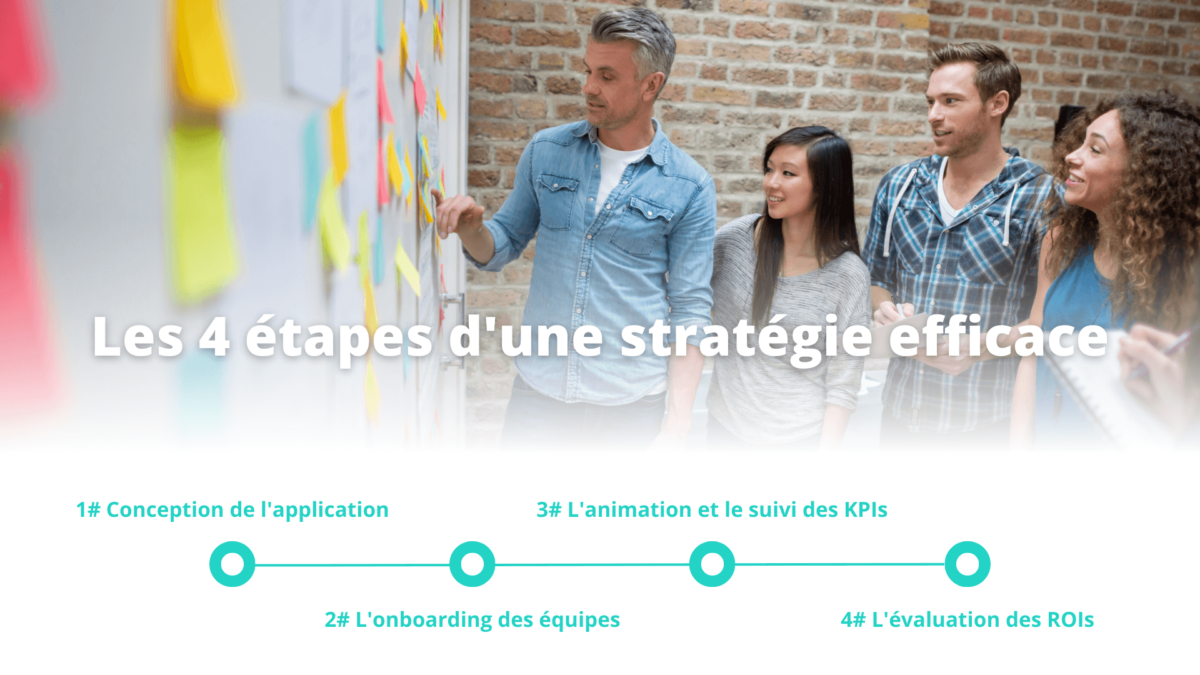
1 – La conception de l’application : un travail de co-construction !
Pour réussir la conception d’un outil d’aide à la vente, il est important de dissocier la création de l’arborescence de la création graphique. Concentrez-vous dans un premier temps à 100% sur le squelette de l’application en veillant à bien y impliquer les équipes sales & marketing. C’est ce qui va vous permettre de créer des parcours de vente pertinents et en cohérence avec votre approche commerciale. Que vous ayez une approche par profil d’acheteur, type de rendez-vous, secteur d’activité, marque ou encore type de produits, toutes les approches sont possibles avec Salesapps. Une fois l’arborescence finalisée, vous pourrez commencer à travailler sur l’habillage graphique avec les personnes concernées. Le succès de cette phase est la co-construction ! Si vous le faites sans associer l’une des parties notamment les sales, il y a de fortes chances que vous oubliez les points liés à la contextualisation des rendez-vous alors qu’il s’agit de ceux qui font la différence en clientèle.
En ce qui concerne l’application en elle-même, elle doit être ergonomique et super intuitive. Pourquoi ? L’enjeu c’est que votre application soit utilisée par le client en rendez-vous. Et pour qu’elle soit utilisée en rendez-vous, elle doit donner envie, être fluide pour le commercial, répondre aux enjeux du rendez-vous et être le plus immersive possible pour l’acheteur. Elle doit donc être bien conçue. Un autre point important est d’identifier les thématiques documentaires et les contenus clés. L’objectif n’est pas d’assommer avec des milliers de contenus, mais de mettre à disposition des contenus marketing utiles et qui font mouche en rendez-vous.
2 – L’onboarding des équipes : comment réussir son lancement ?
Dès lors que vous impliquez les équipes Sales & Marketing dans la conception de l’outil, vous partez avec un point positif ! En effet, en impliquant les équipes terrain, vous garantissez la pertinence de l’outil déployé. Faites un Teaser pour découvrir l’application et donner l’envie de l’utiliser dès qu’elle sera disponible. L’objectif est de créer de l’engouement dès le lancement, de présenter les fonctionnalités, de faire découvrir les enjeux et ce que cela va apporter aux commerciaux. On nous demande régulièrement s’il y a un bon moment ou un meilleur moment pour lancer l’application ? Vous pouvez le faire en fonction de votre actualité (séminaire, lancement de produit…) ou des temps forts de votre activité. Pour les groupes de moins de 200 personnes, les pilotes sont rares, à l’exception des contextes internationaux ou des organisations par Business Unit très autonomes. C’est aussi à cette étape du projet que le Business Sponsor doit se mettre en avant, promouvoir la solution et les enjeux qu’elle adresse !
3 – L’animation et le suivi des KPIs : une application vivante sera performante !
Une application performante doit être vivante. Pour faire vivre une application, il faut mettre à jour ses contenus et les mettre en avant. Grâce à l’application, vous pouvez mettre en avant vos contenus de manière différente : en les soulignant avec une animation particulière, en envoyant des notifications aux utilisateurs en les liant à vos espaces ou contenus (notifications push distribuées sur tablette, PC et téléphone). Vous pouvez pousser des actualités et stimuler des remontées du terrain. Une application de ce type est pertinente si vous remontez spontanément un certain nombre d’informations du terrain. L’outil vous permet de le faire en direct depuis l’application si le commercial veut suggérer de nouveaux contenus, remonter une information concurrentielle ou signaler une erreur. Tout se passe par l’application !
L’application de Sales Enablement intègre également des logiques de gamification pour stimuler l’utilisation de l’outil et tirer les équipes vers le haut. À ce stade du projet, vous pilotez l’activité des sales à travers les KPIs mis à votre disposition ! Une plateforme de Sales Enablement permet d’en mesurer plusieurs : taux d’onboarding, taux d’utilisation, parcours de vente suivi, contenus consultés et partagés, taux de lecture de vos clients et prospects, taux de relecture, participation à la formation, niveau de maîtrise des offres, données remontées dans votre CRM.
4 – L’évaluation des ROIs : mesurez votre création de valeur !
Reste plus qu’à évaluer le ROI de votre stratégie de Sales Enablement. Ils sont identifiables au travers de 4 axes :
– Vendre plus et mieux : comment on fait ? En dégageant du temps sur les tâches administratives, le commercial peut faire plus de rendez-vous, ce qui va avoir un impact positif sur les revenus de l’entreprise et ses marges (+5% à 15% de CA, +10% de rendez-vous, augmentation du taux de ventes croisées, des upsell).
– Attractivité et rétention des commerciaux. L’application de Sales Enablement renforce l’attractivité de votre marque et projette le commercial dans sa future activité. Elle lui permet d’accélérer sa montée en compétence et d’atteindre plus rapidement ces objectifs. Il est plus autonome pour s’approprier les offres et devient confiant dans son pitch (-60% sur le temps de montée compétence, -30% sur le turnover des commerciaux).
– Un CRM plus riche en data ! L’application automatise le compte-rendu de visite dans le CRM, sans l’intervention d’un commercial, et en s’appuyant simplement sur le déroulé de son rendez-vous et des contenus qu’il a présenté. La collecte est efficace et les données fiables pour éclairer les décisions de la direction marketing & commerciale ! (100% de CR de rendez-vous dans le CRM).
– Pleinement inscrit dans votre politique RSE ! L’application permet de centraliser l’ensemble de vos contenus marketing, les rendant facilement accessibles de manière 100% offline. Résultats ? Moins d’emails et moins de papiers dans votre entreprise (-90% sur le budget print). L’application s’avère être un très bon outil d’aide à la vente quand il s’agit d’accompagner le commercial dans ses rendez-vous à distance, ce qui lui permet de limiter ses déplacements.