Blog
Sales Enablement and ROI: Where to Start, and How Far to Go?

After defining the right KPIs and structuring how management will oversee them, one final question arises in the executive committee: where is the return on investment in all of this? This is the moment of truth that most sales departments currently facing an AI transformation are experiencing.
The basics in 30 seconds
- The ROI of business AI doesn't just happen overnight: it's built step by step, with proof at each stage.
- The first step—and the most defensible one at Comex—is measurable productivity and the time saved on non-value-added tasks.
- Next comes the predictability of the forecast, followed by direct growth (conversion rate, average order value, velocity).
- The autonomy granted to AI must be based on the maturity of the data and processes, never on technological ambition alone.
- A solid business case includes the baseline, scenarios, total cost of ownership, and compliance.
The Moment of Truth: After the Enthusiasm Comes the Challenge
Two years ago, the question on the executive committee’s agenda was simple: Should we invest in AI? Today, the situation has changed: Where is the return on investment? This shift does not indicate any disillusionment; rather, it reflects a newfound maturity. Organizations have experimented, activated licenses, and launched pilot projects. Now, they are demanding quantifiable evidence.
The problem often stems from a step that was overlooked at launch. Many companies rolled out the technology before deciding how they would measure its impact—and, more importantly, before establishing a framework for collecting the data that powers these tools. The result is predictable: inconsistent use of the tools, scattered benefits, and an inability to build a business case that would justify scaling up.
The context in two figures
The ROI Ladder: A Path, Not a Promise
The idea isn’t to deploy commercial AI and then wait to see what it produces. It’s better to map out a well-thought-out, step-by-step path. The image of a staircase helps illustrate the logic: first, you prove profitability within a limited scope; then you scale up what works; and finally, you implement the transformation on a broader scale. Each step has its own value and paves the way for the next.
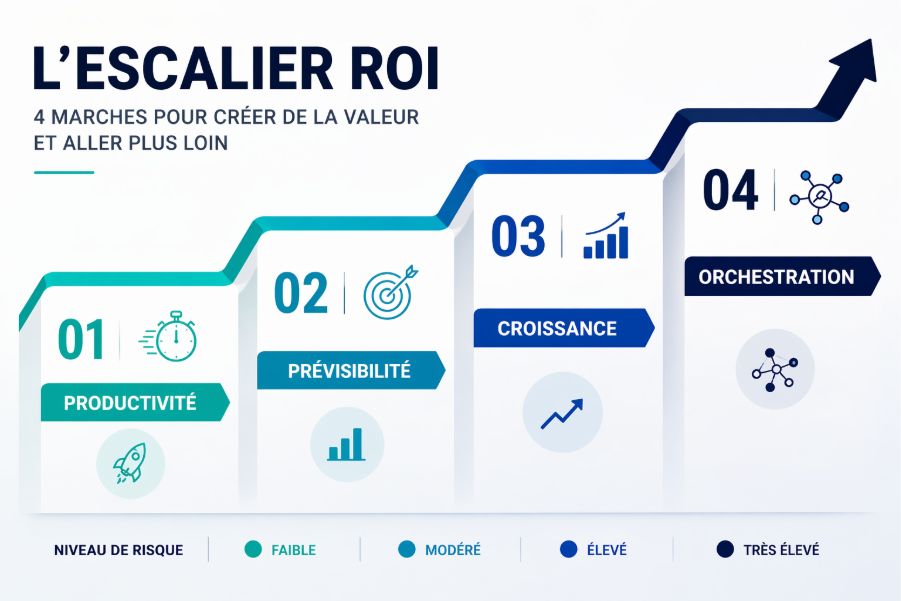
This approach reflects a key organizational reality: business change takes time. Teams must adopt new habits, managers must learn to coach differently, and sales enablement processes must evolve. Trying to jump straight to orchestration using autonomous agents without first validating simple use cases exposes the company to certain failure.
Measurable Productivity
The starting point recommended by all practitioners is the same: begin where the cost is visible, the benefit is clear, and organizational change is minimal. Business productivity—that is, the time freed up from low-value-added tasks—is the ideal target.
If sales sales reps s spend about 70% of their time on tasks unrelated to direct sales, any reduction in that ratio offers immediate economic potential. Automated note-taking, draft follow-up emails, assisted CRM updates, and faster appointment scheduling: these time savings are real, immediate, and quantifiable.
Salesapps has allowed us to virtually cut the time spent preparing for visits in half.
Patrick Vissac, National Sales Director, Moët Hennessy Diageo
Calculating a simple business case then becomes easy. Let’s look at a clear example: a time savings of 45 minutes per appointment, with 8 appointments per week and an hourly labor cost of 45 euros. The savings amount to approximately 14,000 euros per year per sales representative. For a sales force of 50 people, the productivity potential reaches 700,000 euros — and that’s before even considering any impact on revenue.
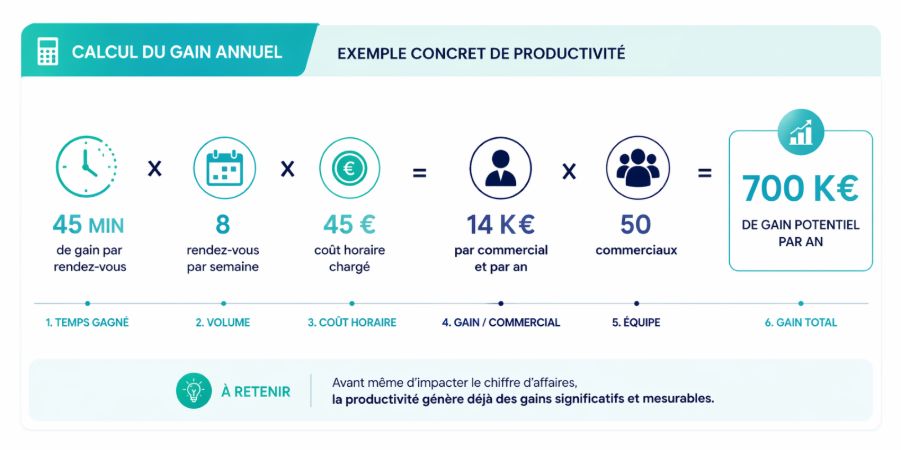
A Forrester TEI study commissioned on Microsoft Copilot for Sales in 2024 highlights these drivers. While it should be contextualized based on your specific market, it provides a very useful framework for calculating your internal assumptions.
The Predictability of the Forecast
The second step doesn't get as much attention in presentations, but it is highly valued by senior management and finance teams: the predictability of the forecast. Analyzing past results remains useful, but the strategic challenge is to use that information to make better decisions sooner.
Reducing the gap between forecasts and actual results does not directly increase revenue. However, it does reduce the costs associated with poor decisions. A 15% forecasting error on a volume of 50 million euros leads to misallocated resources: delayed hiring, poorly calibrated marketing budgets, inadequate inventory, or last-minute, panic-driven discounts at the end of the quarter. Sales Enablement and sales AI make this data more reliable and safeguard profitability. This is where the right sales metrics make all the difference.
Direct Growth
Once the signals are in place and a management framework is established for RevOps, AI becomes a true driver of direct growth. It enables better prioritization of high-potential opportunities and greater customization of sales journeys based on the buyer’s profile. Improvements to the next steps in the sales cycle become systematic thanks to the tool’s recommendations. This has a positive impact on the conversion rate, average order value, and sales velocity.
sales reps s have better control over their proposals, customers understand them better, and sales are increasing. Since the rollout, the number of appointments per sales representative has increased, and as a result, the entire business has seen an uptick.
Vianney Leveugle, Director of Marketing and Customer Relations, GEODIS Distribution & Express
Market Benchmarks
Orchestration and Autonomous Agents: How Far Should We Go?
This is the key question for sales management teams in the coming months. There are four levels of AI integration, each with a distinct return on investment and risk profile.

Assistance (the co-pilot). AI helps salespeople do what they already do even better: preparation, suggestions, meeting summaries. The risk is low, and the payoff is quick.
Recommendation. The tool prioritizes actions, suggests the ideal content, and identifies at-risk opportunities. Adoption requires more effort, but the value increases.
Orchestration. AI coordinates multiple actions in a continuous workflow: follow-up sequences, manager alerts, and automatic CRM updates. The financial potential is significant, but the organizational change is substantial.
Autonomous agents. AI acts independently on certain tasks. The theoretical benefit is maximized, but the management of reputation, compliance, and governance risks must be flawless.
The golden rule remains strict: the level of autonomy granted to AI must be based on the maturity of the data, processes, and governance—not just on technological ambition. Skipping these steps leads straight to project failure. This is also what AI agents deployed gradually—from co-pilot to orchestration—enable.
See it in action
Align Your ROI Business Case with Your Own Assumptions
In 20 minutes, our experts will help you identify your starting point on the ROI ladder and model your teams’ productivity potential.
Request a demoThe ROI Business Case: What the Executive Committee Needs to Challenge
A credible business case for commercial AI fits on one page and is based on rigorous data. Its structure revolves around four key areas.
The baseline. Before calculating a gain, you need to assess the initial situation: the ratio of sales time to administrative time, the historical accuracy of the forecast, the average sales cycle length, and the cost of acquisition. This data forms the basis for a sound case to present to the CFO.
Scenario-Based Assumptions. A good proposal presents three distinct scenarios (conservative, base, and optimistic). It models productivity, conversion rates, average order value, and predictability.
Total Cost of Ownership (TCO). A common mistake is to overlook ancillary costs. In addition to licensing fees, you must factor in integration, data migration, training, internal support, and usage costs associated with AI models.
Evidence-Based KPIs. You don’t justify an investment based on mere belief. You need to define clear adoption and performance metrics even before deployment.
The 3 Keys to Profit
Beyond the deployment ladder, the value created can be seen on three levels, ranging from the most immediate to the most strategic.
Productivity
Reduced preparation time and CRM automation.
Predictability
Pipeline reliability and reduction in dead deals.
Performance
Increase in the win rate and average order value.
The ROI We Often Overlook: Compliance
There is one aspect of return on investment that is consistently missing from presentation materials: compliance. The CNIL’s 2024 recommendations on the use of personal data and the European Commission’s 2025 code of good practice are operational realities that must be taken into account, as highlighted in our analysis of AI security in a commercial context.
Compliance offers two key benefits. First, it prevents very costly crises: fines, project suspensions, and reputational damage. Second, it facilitates scaling up. No major partner or public-sector buyer will approve an AI deployment without solid safeguards. Governance is not an additional burden; it is a catalyst for growth.
Conclusion
Sales enablement and sales AI do deliver a return on investment. But it never just falls from the sky. It comes from a disciplined approach to implementation, rigorous measurement, and sound prioritization. The organizations that make the most progress start on a limited scale, quickly demonstrate value, document use cases, and then scale what works to the rest of the company. This is exactly the approach we support at Salesapps: a proof of concept allows you to define—based on your own assumptions—the business case tailored to your organization and your priorities.
Key takeaways
5 Key Takeaways
- The financial return on commercial AI is built in stages, with a proof-of-concept approach at each level.
- Measurable sales productivity is the first step—the most accessible and the easiest to justify to the executive committee.
- Improving the accuracy of forecasts reduces losses resulting from poor decisions and misallocated resources.
- The autonomy granted to algorithms must always be proportional to the maturity of your processes and data.
- A business case that incorporates total cost of ownership (TCO) and compliance holds up much better when it comes to questions from RevOps and finance.
Frequently Asked Questions About Sales Enablement ROI
Where should you start to get the most out of business AI?
Through measurable productivity: time saved on low-value-added tasks (note-taking, preparation, updating the CRM, follow-up emails). The cost is transparent, the benefit is clear, and organizational change is minimal, making this the easiest proposal to defend before the executive committee.
How do you build a credible ROI business case?
Based on four key areas: a measured baseline (sales time vs. administrative time, forecast accuracy, cycle time, acquisition cost), assumptions across three scenarios (conservative, base, optimistic), total costs (TCO, beyond just licenses), and performance KPIs defined prior to deployment.
What is the ROI Ladder in Sales Enablement?
A phased approach: First, we demonstrate profitability within a limited scope (productivity); next, we improve the reliability of the forecast; and finally, we drive direct growth. Each step has its own value and paves the way for the next, which prevents us from trying to jump straight to autonomous agents.
How far can we go in terms of the autonomy of commercial AI?
There are four levels: assistance (co-pilot), recommendation, orchestration, and autonomous agents. The return and the risk increase with each level. The golden rule: the level of autonomy must be guided by the maturity of the data, processes, and governance—not by technological ambition alone.
Why Include Compliance in the ROI Calculation?
Because it offers a twofold benefit: it prevents significant crisis-related costs (fines, project shutdowns, reputational damage) and facilitates scaling. No major partner or public buyer will approve an AI deployment without solid safeguards. Governance is a catalyst for growth, not an additional burden.
Take action
Build the ROI business case for your sales enablement
In just 20 minutes, learn how to identify your starting point, demonstrate value within an initial scope, and build—using your own assumptions—a case that stands up to scrutiny from RevOps and finance.
Request a personalized demoOther articles that might interest you: