
Blog
Driving Sales Performance: Focusing on Process Rather Than Just Commenting on Results

Oncethe KPI framework is in place and the data is being collected properly, the most difficult question remains: what do we actually do with it on a day-to-day basis? Even the best metrics in the world are useless if they don’t fuel dynamic managerial leadership. This is precisely where many organizations stumble.
The basics in 30 seconds
- Even the best KPIs are worthless if they don't inform day-to-day management activities.
- Managing performance means taking action on today’s execution, not commenting on yesterday’s results, which are already set in stone.
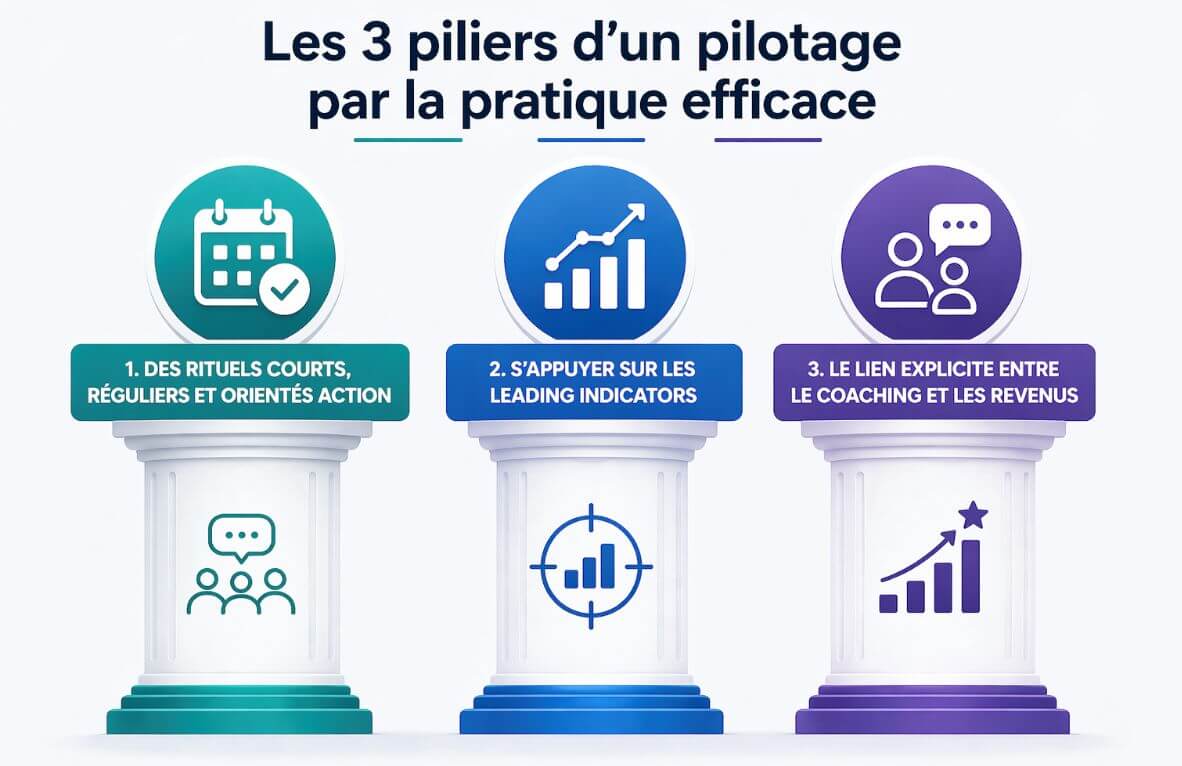
- This workshop is structured around three pillars: short, action-oriented rituals; leading indicators rather than lagging indicators; and an explicit link between coaching and revenue.
- Four levels of management that should never be confused: practice, competence, system, and results.
Why the "review of results" ritual is no longer enough
In many sales departments, the monthly pipeline review remains a deeply ingrained ritual. During the meeting, figures are presented, discrepancies are discussed, those responsible for lost opportunities are identified, and promises are made to follow up on overdue leads. Once the exercise is over, the presentations are put away until the following month. And if targets aren’t met, the conclusion all too often boils down to a single accusation: the teams didn’t try hard enough.
This model has a structural flaw. It relies exclusively on historical data. By the time the review takes place, the results are already set in stone, and it is too late to change the course of the quarter. The only real leverage lies in what the teams are doing today, on the ground, and not solely in analyzing what they produced yesterday.
Driving sales performance isn’t about choosing between results and execution. It’s about not waiting for the former before taking action on the latter. In a B2B ecosystem where sales cycles are getting longer and purchasing committees are becoming more complex, it’s this ability to anticipate that makes all the difference.
The Starting Point: The Physics of Business Time
One statistic stands out above all others. Sales teams spend about 70% of their day on tasks that are not directly related to selling: preparing for meetings, entering data into the CRM, internal coordination, and administrative work. In other words, the company is primarily funding non-sales activities.
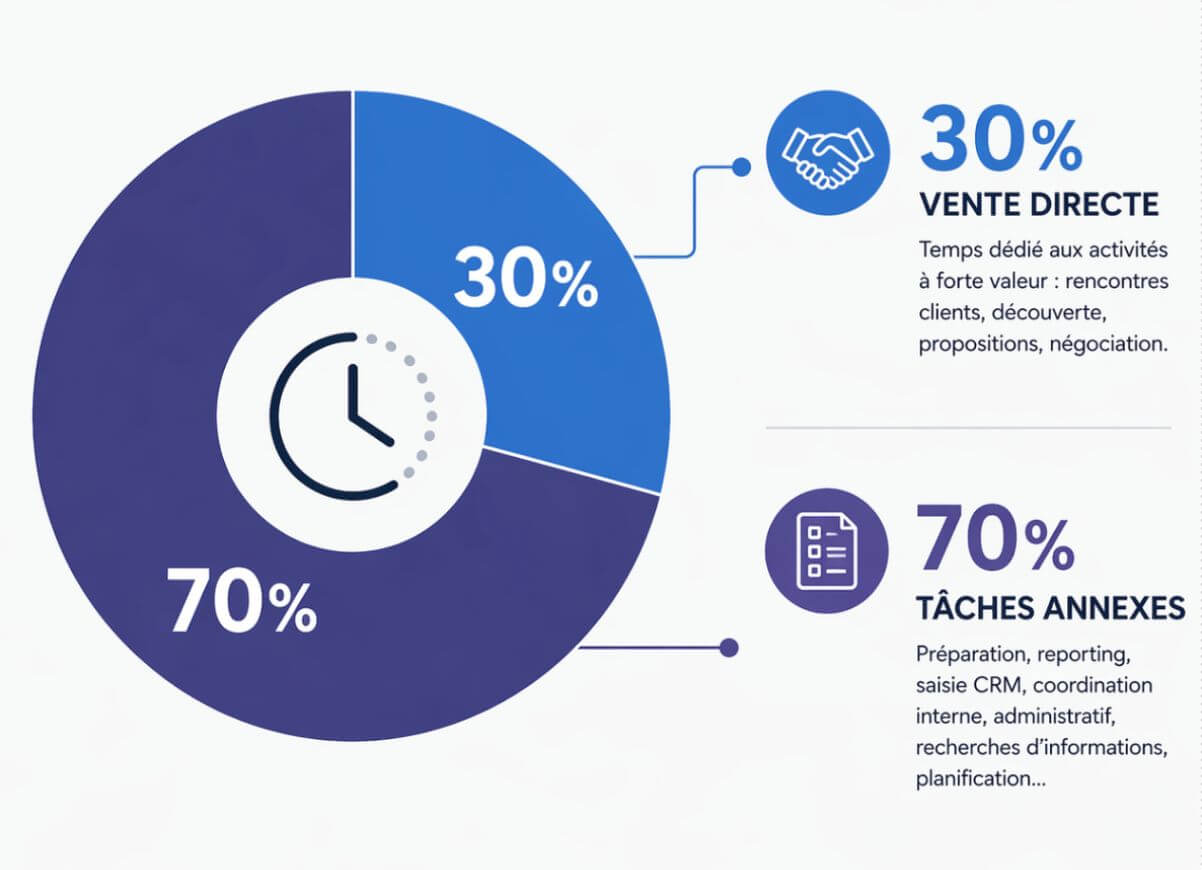
This imbalance does not reflect a lack of motivation or a shortage of talent. It points to a problem with organizational infrastructure. A large part of sales performance depends on the architecture of the sales system—RevOps—rather than on managerial coaching.
This is precisely where a well-deployed commercial AI comes in handy. It automates low-value-added tasks, enriches the information available as work progresses, and helps sales reps better prepare, document, and follow up. But this power is only valuable if management knows how to use it rigorously on a daily basis, and if the data fed into the algorithms is itself reliable.
Coaching: A Measurable Economic Driver
What “facilitating practice” means
Developing sales skills starts with a simple idea: selling relies less on spur-of-the-moment inspiration than on the quality of one’s habits. The best sales reps aren’t successful because they improvise better than others. They succeed because they consistently repeat effective behaviors when handling objections, during key meetings, and throughout complex sales cycles.
The manager’s central role is therefore no longer to keep an eye on the final results, but to create the conditions for these high-performance behaviors to spread throughout the team and endure over time. This is the essence of leadership that truly energizes a sales team rather than merely supervising it from a distance.
Sales Enablement has helped us structure our meetings by simplifying our storytelling. The various sales journeys tailored to our market challenges allow us to approach our pitches with confidence for each prospect and to support our sales arguments with tangible evidence.
Thomas Thierry, Director of Sales & Specifications, Actis Isolation
The 3 Pillars of Effective Practice-Based Management
Sustainable, practice-based management rests on three pillars. None of them works in isolation; it is their combination that creates a dynamic of continuous improvement.
Short, regular, and action-oriented rituals
The number one enemy of putting theory into practice is the exceptional and never-ending event: the big monthly meeting. These formats are designed to inform, never to change behavior. Changing a business habit requires weeks of repetition, not a top-down monologue.
The format that works takes just a few minutes: short weekly check-ins, lasting 15 to 20 minutes, focused on a single question: “What are we going to do differently this week to change our course?” A clear action, a designated person in charge, a specific deadline—and nothing more.
Rely on leading indicators, not lagging indicators
A lagging indicator measures what has already happened: revenue, final conversion rate. A leading indicator measures what will happen: the volume of qualified opportunities generated, the speed at which incoming leads are processed, the depth of the discovery phase, and the level of multithreading on complex accounts.
A leading indicator that measures the causes of future performance rather than its past effects. It allows for timely action on execution, whereas a result indicator merely records what has already happened.
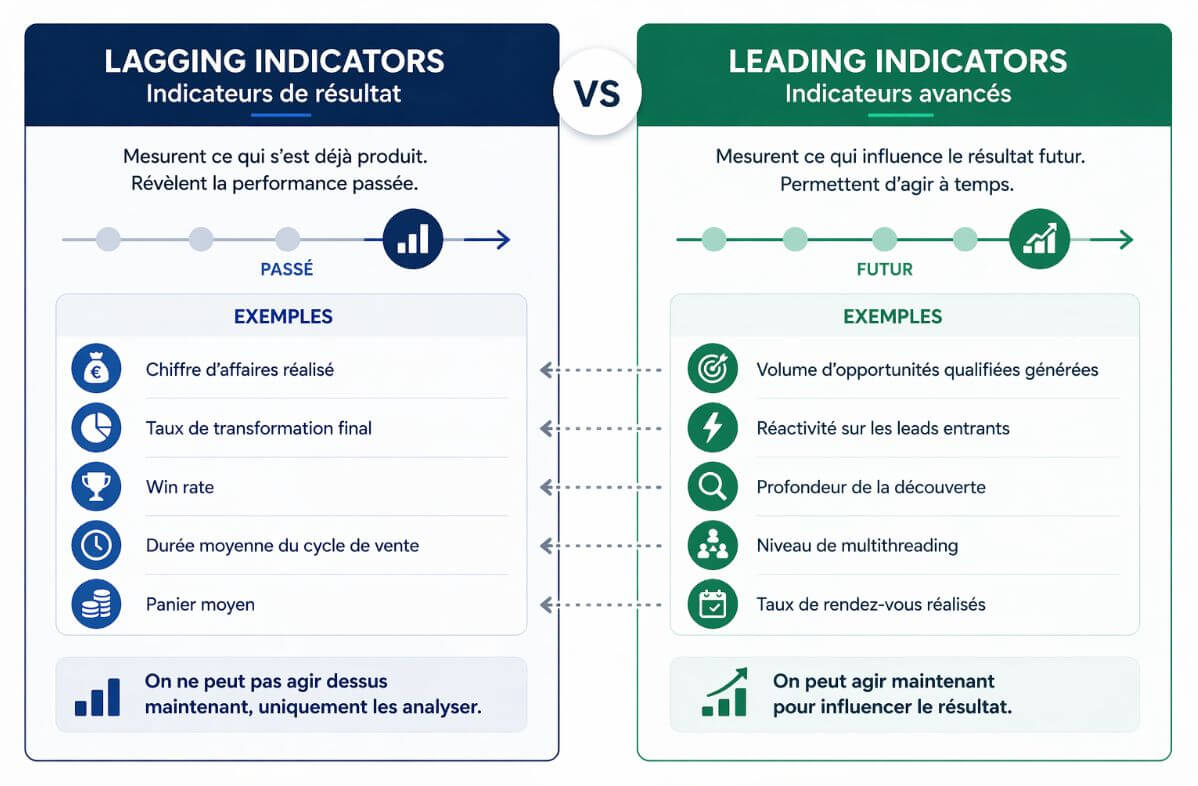
Managing based on leading indicators forces management to focus on the root causes. This is a demanding task, as it requires actively influencing behavior rather than passively observing the results. Sales enablement and conversational analytics tools now capture these signals at the source—such as preparation time, depth of discovery, and multithreading—and AI processes them into a format that managers can use, without imposing a reporting burden on salespeople.
The Clear Link Between Sales Coaching and Revenue
Coaching is neither a mere “soul supplement” nor an optional HR exercise: it is a direct driver of economic growth. Teams that take it seriously—much like how a top-level sports team is coached—see their win rate increase and are better able to retain their top talent. However, this requires reliable data to coach based on measurable metrics, rather than on gut feelings. This is precisely the purpose of a dedicated solution designed to train and coach your sales reps based on performance data.
See it in action
What does this initiative look like in your organization?
In just 20 minutes, our experts will show you how Salesapps prepares you for sales meetings and turns performance data into weekly coaching insights.
Request a personalized demoThe Operational Structure: The 4 Levels of Management
A structured, practice-based management approach is organized into four distinct layers. Confusion between these levels of analysis is one of the most common causes of managerial inefficiency: managers try to improve an employee’s skills when the problem actually lies with the system, or they call out a sales representative when the real cause is a faulty CRM database.
| Level | What We Drive | Examples of KPIs | Rhythm | Lead Actor |
|---|---|---|---|---|
| 1. Practice | Day-to-day operations. What actually happens on the ground. | Opportunities actively pursued, responsiveness to incoming leads, preparation time. | Daily / Weekly | Sales Representative & Field Manager |
| 2. Jurisdiction | The quality of execution. The way the task is carried out. | Depth of insight, mastery of the pitch, clear articulation of the next steps. | Weekly | Enablement Manager & Coach |
| 3. System | Infrastructure. What makes this execution possible. | Adoption of tools, freshness of content, and accuracy of the CRM database. | Monthly | RevOps Team & Sales Management |
| 4. Result | The economic implications of the three preceding levels. | Win rate, cycle time, average basket size, forecast accuracy. | Quarterly | Comex & Executive Management |
Our sales reps have access to up-to-date marketing information at any time. The tool’s flexibility makes it possible to create relevant sales funnels that salespeople can easily view and share. It’s an excellent tool for ensuring that information is always up to date.
Olivier Laporte, Bakery and Pastry Category Manager, France Frais
How AI Is Changing the Economics of Sales Management
Senior management often underestimates an invisible cost: the managerial time consumed by administrative oversight. Tedious individual tasks and the search for information in the CRM system drain the energy of highly experienced professionals, who should be focusing on supporting key accounts.
Modern sales enablement technologies, combined with AI, eliminate this friction. By leveraging automated activity tracking, they free up senior staff’s time for high-impact leadership activities. This transforms the very nature of sales management.
Nevertheless, we must be wary of the illusion of absolute control. When all activities are digitally tracked, managers face the temptation to micromanage. A team that feels monitored rather than supported will see its engagement plummet. Choosing a limited number of metrics for day-to-day management—and accepting that the rest of the data is used solely for diagnostic purposes—is a managerial decision, not a technical one.
What the Comex Needs to Remember
Growth isn’t something we simply discuss in executive committee meetings. It’s an operational practice that we rigorously orchestrate. Behind this concept lie very real initiatives: reimagined managerial practices, coaching based on objective data rather than intuition, and a pragmatic use of artificial intelligence to significantly enhance the monitoring and support of teams.
B2B companies that have made this transition no longer feel the pressure of the end of the quarter. They move forward with teams that know what’s expected of them, why it’s being measured, and how to improve. The competitive advantage is solid—and, above all, difficult to replicate. That’s the promise of a platform like Salesapps, which supports sales meetings and transforms execution data into coaching insights.
Key takeaways
5 Key Takeaways
- Practice-based management does not replace results; rather, it allows usto take action early enough to influence them.
- A large portion of business inefficiencies stems from organizational issues and administrative tasks, which AI can nowautomate.
- Effective facilitation relies on short, action-oriented rituals, the use of leading indicators, and systematic coaching.
- Performance data provides a factual basis for coaching and helps avoid managing based solely on intuition.
- Automation should not devolve into micromanagement: metrics are primarily intended to support and develop the team.
Frequently Asked Questions About Sales Performance Management
What is the difference between lagging indicators and leading indicators?
A lagging indicator measures what has already happened: revenue, win rate, and final conversion rate. We can no longer influence these factors; we can only analyze them. A leading indicator measures what is going to happen: volume of qualified opportunities, velocity on incoming leads, depth of discovery, and multithreading. It is on these factors that management can take timely action.
Why is the monthly pipeline review no longer enough?
Because it relies on data that is already set in stone. By the time the review takes place, the quarter’s trajectory is largely set. Commenting on discrepancies after the fact does not change behavior. The real leverage lies in fostering daily practices: short rituals that influence current execution rather than past results.
What Is Practice-Based Management in Sales Performance?
This is a managerial approach that views sales as a matter of habits rather than inspiration. Managers no longer focus solely on the final results; instead, they create the conditions for high-performance behaviors (preparation, prospecting, follow-up, multithreading) to be repeated and spread throughout the team, week after week.
What are the four levels of sales management?
The operational level (actual day-to-day activities), the competency level (the quality of execution), the system level (the infrastructure, tools, and data that enable this execution), and the results level (the economic impact: win rate, cycle time, average basket size, forecast). Confusing these levels leads to addressing a symptom in the wrong place.
How Does AI Improve Sales Coaching?
By automatically capturing performance metrics (preparation time, depth of discovery, multithreading) and presenting them in a format that managers can use, without requiring any reporting from the sales representative. Coaching is then based on objective, measurable data rather than on gut feelings, which makes it significantly more effective and better accepted by the teams.
How can you avoid slipping into micromanagement?
By separating two uses of the data. A limited number of metrics are used for day-to-day management and team support; the rest are used solely for diagnostic purposes, without becoming a tool for individual monitoring. A team that feels supported is committed; a team that feels spied on loses motivation. This is a managerial decision, not a technical adjustment.
Take action
Boost your teams' performance with Salesapps
In just 20 minutes, learn how to prepare for sales meetings, track performance data, and turn it into weekly coaching—so you’ll never have to struggle through the end of the quarter again.
Request a personalized demoOther articles that might interest you: