Blog
AI data security: using AI without exposing yourself
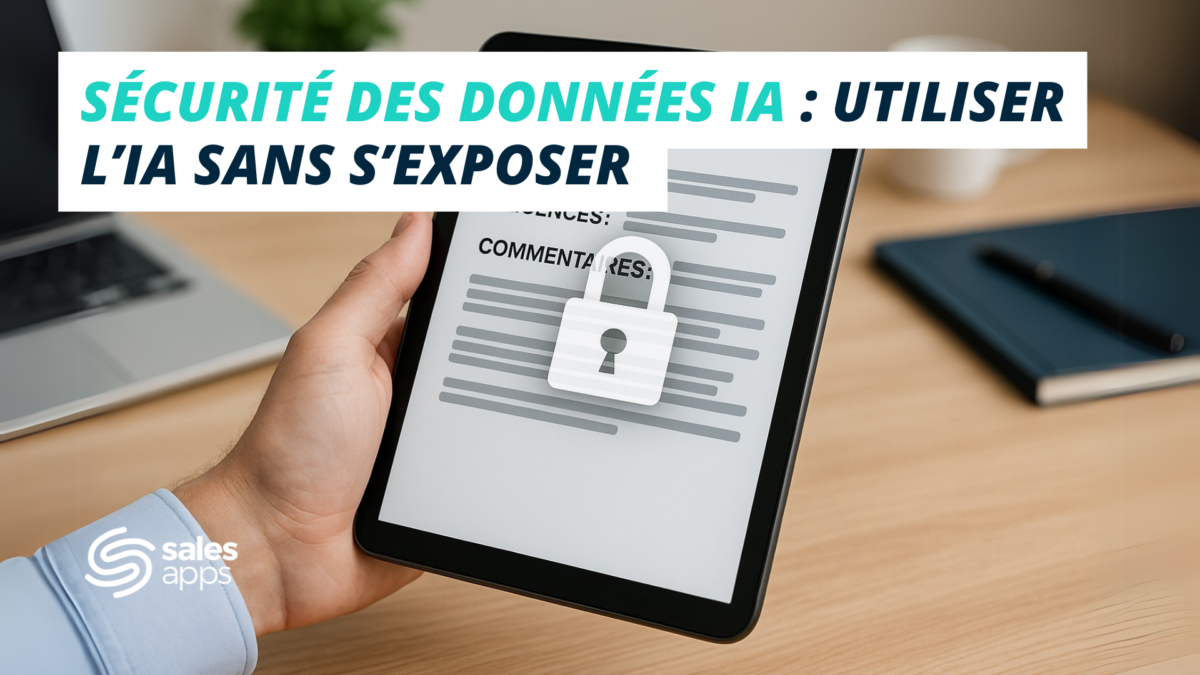
Given the rapid adoption of AI in business tools, more than 50% of marketing decision-makers and sales reps expect AI to improve operational efficiency (Action Co. Study). But while AI promises quick gains, it also raises a strategic imperative: ensuring the security of sensitive AI data used on a daily basis. Confidentiality, anonymization, and control over data flows: how can companies leverage these new tools without exposing commercial or strategic information?
AI data security refers to the set of technical and organizational mechanisms that enable a company to use artificial intelligence tools without exposing its sensitive data: customer data, contractual information, business strategies, or personal data subject to the GDPR.
The basics in 30 seconds
- 82% of French companies are considering banning certain generative AI tools due to risks related to data security and privacy (Archimag).
- The real risk isn't the tool itself, but the lack of a framework: a simple prompt can reveal an account name, a project phase, or a strategic objective.
- AI intermediation acts as a firewall: it anonymizes and filters data before sending it to an external AI engine.
- Salesapps incorporates this layer by design: your sales and marketing teams can use AI without ever exposing information that needs to remain confidential.
Contents
AI in Marketing and Sales: Huge Opportunity, Real Exposure
As marketing and sales teams increasingly adopt tools that incorporate artificial intelligence, one question keeps coming up: What happens to all my data? Behind automation, recommendations, and predictive analytics lies another, less transparent reality: data flows—which are sometimes poorly managed—expose potentially critical information without this always being apparent.
The context in two figures
Marketing and Sales Tools: AI Is Present but Lacks a Clear Framework
AI has quietly made its way into all our everyday tools: enhanced CRM systems, marketing automation platforms, chatbots, content generators, automated note-taking solutions, sales enablement tools…It speeds things up, automates processes, and makes life easier. But amid this proliferation of features, one question often goes unanswered: what does the tool actually do with the data we entrust to it?
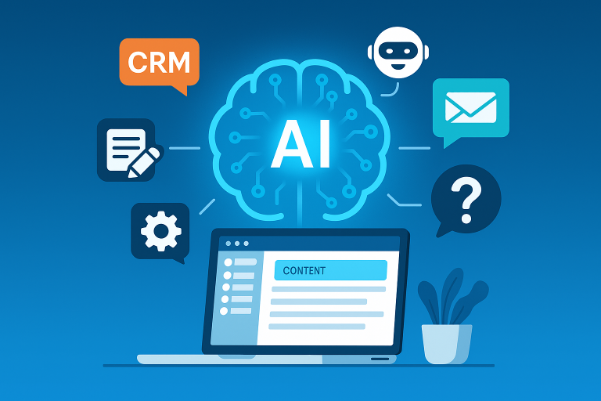
In most cases, users do not have a clear understanding of what the AI collects, stores, or infers. Entered prompts, summarized documents, or analyzed profiles can feed into models whose inner workings remain opaque, even to internal teams. It is this lack of transparency that concerns many companies—and explains the rise of the concept of AI data security.
| Tool Type | Built-in AI feature | Risks Associated with Uncontrolled Treatment |
|---|---|---|
| CRM | Predictive scoring, automatic enrichment | Implicit profiling from sensitive data |
| Emailing / Marketing automation | Generate customized objects or content | Reuse of customer data for non-transparent purposes |
| Chatbots | Lead qualification, automatic response | Transmission of uncontrolled commercial information |
| AI note-taking (meeting assistants) | Meeting summaries, transcripts | Retention of non-anonymized strategic discussions |
| Content generators | Writing sales messages or scripts | Inadvertent leakage of confidential information via prompts |
Sensitive Data Exposed Without Anyone Knowing It
Even when no customer data is directly transmitted, AI tools can reconstruct a strategic context based on weak signals: a purchase intention, a priority segment, or a project in the works. This is known as implicit profiling.
The real risk does not necessarily stem from malicious intent, but rather from unintentional exposure: data shared without fully understanding the consequences, in an environment where transparency in data processing is not guaranteed.
| Current Business Situation | What AI Can Deduce From This | Associated risk |
|---|---|---|
| Prompt to generate a sales script before an appointment | Account name, sector, issues addressed, purchasing cycle phase | Revelation of an ongoing strategic opportunity |
| Automatic summary of a marketing or sales brief | Targeted products, quarterly targets, customer bread points | Risk of leaking the roadmap or strategic issues |
| Request for help writing a LinkedIn message | Sales approach intention, targeting strategy, precise persona | Prospecting plan disclosure risk |
In each of these cases, no sensitive data is explicitly sent —but the system can infer a great deal from it, especially without an intermediary or anonymization layer. It is precisely this gray area that compromises the security of AI data. And in a B2B environment, every breach can be costly: loss of trust, damage to brand reputation, and loss of competitive advantage.
AI-Powered Intermediation: Filtering Without Slowing Down
Adopting AI in business is not a problem in and of itself. What creates risks is the lack of a framework for data transmission. This is where the concept ofAI intermediation comes into play.
The role of an AI intermediation layer
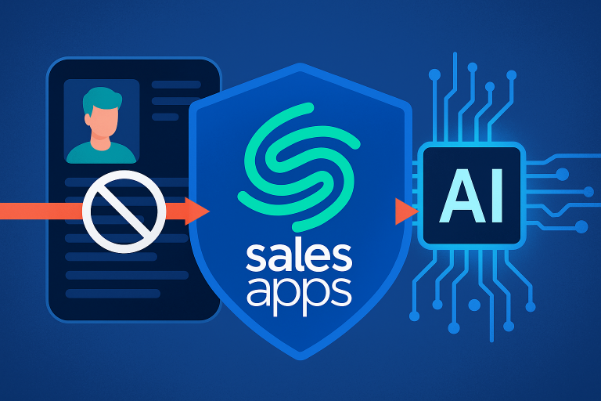
Intermediation acts as a smart firewall. Before data leaves the corporate environment, it is inspected, cleaned, and neutralized. In practice, this means:
- Deletion of names and identifiers (anonymization)
- Elimination of contractual or confidential data
- Decorrelation between the user and the query transmitted to the AI
- Zero storage and no AI learning of processed content
This mechanism makes it possible to harness the power of artificial intelligence—automatic summaries, suggestions, and assisted searches— without ever exposing sensitive data, whether commercial or personal.
Why the method counts more than the tool
What makes AI risky is not so much the tool itself as the way it is used. The same technology can be safe or problematic, depending on whether or not it is properly regulated. It all comes down to the approach: one that allows us to manage data flows, avoid unintended exposure, and maintain control over what AI sees… or does not see.
The Salesapps Approach: A Brokerage Service Designed with Business Security in Mind
Salesapps acts as an intelligent intermediary layer, isolating the data that needs to be isolated before any interaction with the AI engine. It is not a technical overlay added as an afterthought, but an architecture designed from the ground up to secure every query while adapting to the day-to-day realities of your teams.
In practice: Sensitive data is processed locally, in a closed environment. The user’s identity is decoupled from the request: it is impossible to trace the origin or business context. As a result, your marketing and sales teams can use AI with complete confidence—whether for a meeting, a summary, or a recommendation—without ever exposing information that must remain confidential.
Secure AI Agents: What This Means for Your Teams
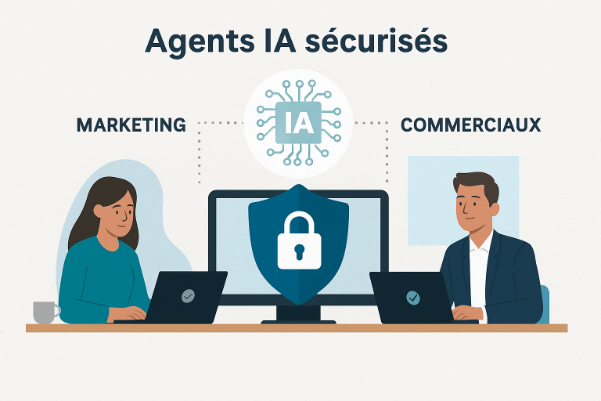
In a secure and controlled environment, AI ceases to be a cause for concern and becomes a driver of operational efficiency. Whena tool is designed with data protection in mind from the outset, teams can use it on a daily basis without hesitation or uncertainty.
Marketing: Produce Faster, Make Better Decisions, Without Alerting the IT Department
In many marketing teams, AI helps speed up time-consuming tasks: analyzing a document, tailoring a proposal, structuring a recommendation, or rewriting content for a specific persona. But in a traditional environment, each use case raises questions: Can we integrate internal data? Where does it go? Who has access to it?
With a secure environment, teams can prototype their materials more quickly without exposing sensitive information and without having to involve the IT department for every test. Strategic data (priority segments, customer insights) remains within the company, without compromise.
sales reps Save time without ever putting an account at risk
Preparing for a meeting, organizing follow-ups, and extracting key points from an internal document: these are all tasks where AI can save valuable time, but which often involve handling critical information. In a secure environment, sales representatives can obtain reliable summaries, organize their meetings, or follow up more effectively—without having to copy and paste customer history into an external tool. AI is becoming an operational asset, not a source of concern.
| Use cases | Risks Associated with Unsecure AI | What's New with Salesapps |
|---|---|---|
| Preparing for a Client Meeting | The prompt may contain an account name or a strategic project → risk of leakage | The profile is generated from data selected by the business teams, drawn from filtered and contextualized public sources |
| Write a summary of an internal meeting | AI can capture and store sensitive information (budgets, objections, contracts) | Information is synthesized locally, without being sent to an external AI engine |
| Analyzing a Strategic Document | Risk that the content could be used to train a third-party AI model | The document is summarized internally, without any external training or storage |
| Follow up on post-appointment actions | Requires manual notes or use of non-compliant tools | A structured and secure report is generated via voice dictation |
| Tailoring the sales pitch | When pitching, you sometimes have to feed personal information into a consumer-grade AI | The pitch is generated from controlled data, without any direct transmission of critical information |
See how AI can work for your teams without exposing your data
In 20 minutes, our teams will show you how Salesapps integrates AI into the day-to-day work of your sales reps marketers, with security built in from the start.
Request a personalized demoHow does Salesapps protect your data?
Beyond anonymization and intermediation, security at Salesapps is based on a comprehensive approach that encompasses technical, organizational, and human aspects. The goal? To ensure that every interaction with AI is traceable, properly managed, and free from the risk of misuse or exposure.
Verifiable guarantees
Salesapps relies on verifiable mechanisms to ensure the responsible use of AI:
- Controlled access to AI features: Each user operates within a defined scope, based on internal rules and the profiles configured in the platform.
- Detailed logs: Every action is logged—who did what, when, and with what data.
- European hosting: Internal AI processing is stored in Europe. When a third-party model is used, data flows are managed to ensure compliance with the GDPR.
A comprehensive privacy policy
Security isn’t limited to servers. It’s also a matter of corporate culture. At Salesapps, simple documentation is provided to every user to ensure responsible use of AI assistants. Short, targeted training sessions are offered so that every employee knows how to use AI effectively without compromising confidentiality. The goal is to ensure that best practices become second nature, without complicating day-to-day work.
Making better use of AI, without compromising your data
AI shouldn’t be a black box to which we blindly entrust our data. When it’s integrated in a controlled manner—through an intermediary layer designed for business realities—it becomes a true catalyst: for sales, for marketing, and for the entire organization. At Salesapps, we believe that the best AI is the kind you can use without hesitation. Thanks to our secure approach, designed with your business needs in mind, your teams no longer have to choose between efficiency and privacy.
Checklist: 4 Best Practices for Ensuring Safe AI Use in the Workplace
- Define permitted use cases: Identify the permitted use cases and the relevant roles before any deployment.
- Avoid uncontrolled data storage or training: choose tools that do not train their models using your data.
- Opt for hosted tools that are GDPR-compliant: choose solutions hosted in Europe, with native encryption and activity logs.
- Train your teams in the responsible use of AI: regularly raise awareness about the risks and implement a simple, accessible policy.
Frequently Asked Questions About AI Data Security
Can AI use my data for training?
Yes, in some cases, particularly with consumer-grade tools. That’s why Salesapps prioritizes offline models or those configured not to reuse the transmitted content. Every interaction passes through an intermediary layer that anonymizes the data before it is sent to an external AI engine.
Do the prompts really contain sensitive data?
Often, yes—even unintentionally. A simple brief or request for a pitch can reveal a client’s name, a project phase, or a strategic objective. This is what’s known as implicit profiling: no sensitive data is explicitly sent, but the system can infer a great deal from the context. Hence the importance of an intermediation framework to mitigate risks.
Is Salesapps GDPR-compliant?
Yes. Salesapps complies with GDPR principles: transparency of data flows, access control, and hosting in Europe. Uses involving external models are clearly identified and regulated. Every user action is recorded in detailed logs, enabling full traceability of data processing.
Why not just use ChatGPT or a free AI tool?
These tools are powerful, but they aren’t designed for supervised professional use. They don’t offer anonymization or control over outgoing data flows. Salesapps offers an alternative that’s integrated into your sales reps marketing tools, with security designed for real-world business scenarios—without putting your sensitive data at risk.
How can I train my teams to use AI responsibly?
With Salesapps, your teams don’t have to become experts in data security. The AI agents are designed to automatically manage usage: anonymization, filtering, and prompt guidance—it’s all built in. Easy-to-access documentation and short training sessions round out the solution. The result: your employees can focus on their core tasks—selling, communicating, and performing—without worrying about risks.
Use AI without putting yourself at risk, with Salesapps
In just 20 minutes, discover how Salesapps enables your sales and marketing teams to take full advantage of AI, with data security tailored to your business needs.
Request a personalized demo